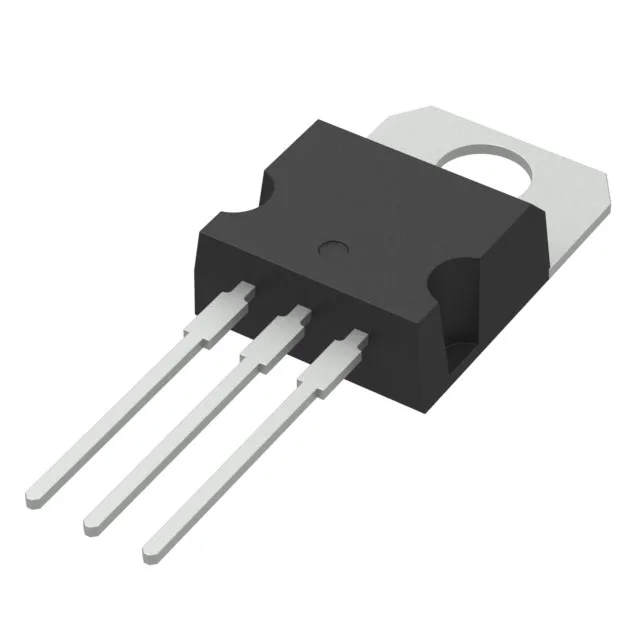
300 V N-channel SuperMESH MOSFET in TO-220
The STP7NK30Z: It handles 5 A continuous drain current at a 25°C case temperature (Tc) and dissipates up to 50 W with an appropriate heatsink.
If your design is still in the layout phase, consider qualifying a current-production alternative in the same TO-220 footprint to avoid a future last-time-buy scramble.
The STP7NK30Z requires a 10 V gate drive to achieve the rated on-resistance. The gate threshold voltage (Vgs(th)) is a maximum of 4.5 V at 50 µA drain current, so a standard 12 V gate drive from a PWM controller or driver IC is sufficient. Total gate charge (Qg) is 13 nC at 10 V, which keeps the gate-drive power modest even at moderate switching frequencies — a 100 kHz switching rate draws about 1.3 mA average from the gate-drive supply. Input capacitance (Ciss) is 380 pF at 25 V drain-source, consistent with a device sized for a few amps. The ±30 V maximum gate-source rating gives ample headroom for driving with a 12 V rail, but a gate-source Zener clamp is still good practice if the gate-drive transformer or bootstrap circuit can overshoot.
Thermal and mounting considerations
The TO-220-3 through-hole package is a standard vertical-mount power package. The junction-to-case thermal path is the primary heat-removal route — the 50 W power dissipation rating assumes a case temperature held at 25°C, which in practice requires a substantial heatsink and thermal interface material. For a 5 A load at 900 mOhm, the junction temperature rise above case is about 5.6 W × RθJC; with a typical RθJC around 2.5°C/W (not in the ledger but implied by the package class), the die runs about 14°C above the case temperature at full rated current. Mount the device with a screw and thermal compound to a heatsink sized for your worst-case ambient.