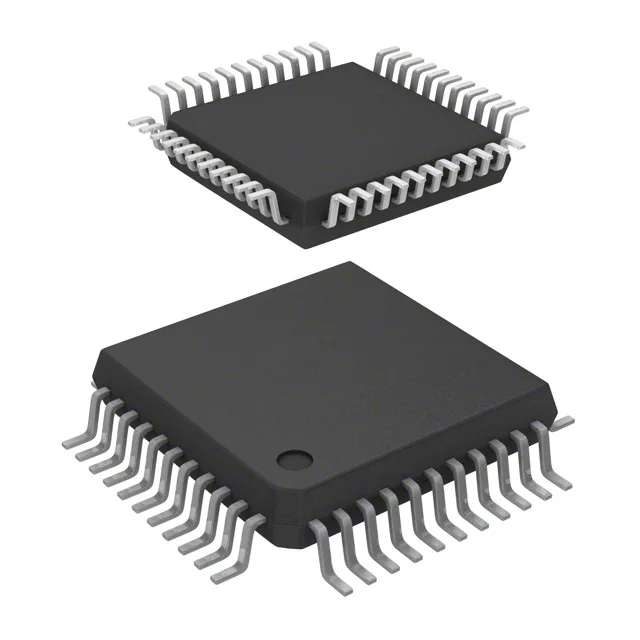
What this 8-bit MCU brings to a control board
The STMicroelectronics STM8S105S4T6C is an 8-bit microcontroller from the STM8S family, built around the STM8 core running at 16 MHz. The 44-pin LQFP package gives you 34 general-purpose I/O lines, plus a 9-channel 10-bit ADC for reading sensors or potentiometers directly. This part is aimed at cost-sensitive embedded control applications: motor drives, appliance user interfaces, industrial sensor nodes, and simple automation panels.
16 MHz core and memory — what fits in the budget
At 16 MHz the STM8 core delivers around 16 MIPS (one instruction per clock on most operations). That is enough for a PID loop running at a few kilohertz, a UART polling routine, and a display update without timing pressure. The 16 KB Flash holds a moderate application — think a fan controller with a few speed profiles and a serial protocol stack. The 2 KB RAM handles a couple of data buffers and a small call stack; if your design needs a large frame buffer or a TCP/IP stack, you will outgrow this memory tier.
Peripherals and connectivity for sensor and actuator interfaces
That covers the common sensor buses (I²C for temperature/humidity sensors, SPI for displays or ADCs) and industrial communication (LIN for automotive subnets, UART for RS-485 converters). The 9-channel 10-bit ADC is adequate for reading analog sensors with a resolution of about 5 mV per count at a 5 V reference. On-chip peripherals include a PWM timer, brown-out reset, and a watchdog — enough to build a reliable standalone controller without external supervisor ICs.
STMicroelectronics lists the STM8S105S4T6C as Active. This part can be designed into new production without worrying about a sudden discontinuation. For BOM planning, the STM8S family has been in volume production for years, so the supply base is mature.