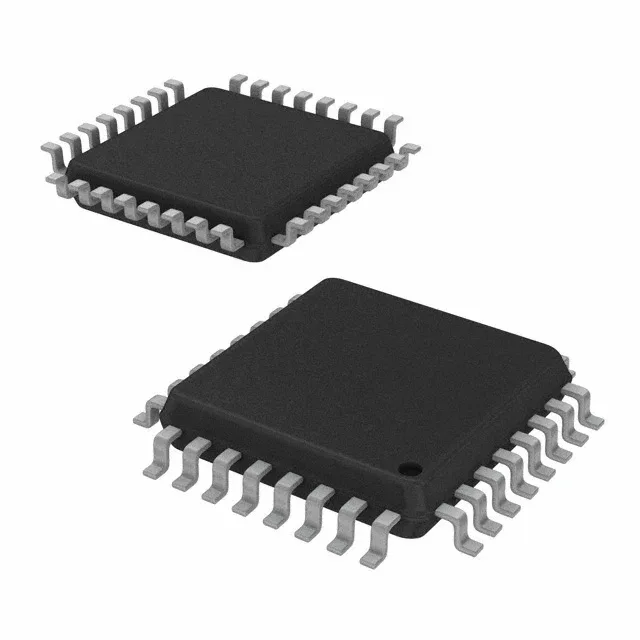
It packs 32 KB of program Flash, 2 KB of SRAM, and 1 KB of data EEPROM — enough for moderate embedded control tasks like motor commutation, sensor fusion, or human-machine interface logic. The EEPROM is separate from the Flash, so calibration constants and configuration parameters survive firmware updates without a dedicated external memory.
The 16 MHz clock rate is the ceiling for this part. At that speed, single-cycle instruction execution on the STM8 pipeline gives roughly 16 MIPS. That is adequate for real-time control loops with loop times in the tens of microseconds — think BLDC sensorless commutation or a PID loop at 20 kHz.
Temperature range and supply — deployment envelope
Brown-out reset and POR are built in, so the part starts cleanly on power-up and resets before the rail drops out of spec.
Peripherals and I/O — what connects
Twenty-five general-purpose I/O pins are available in the 32-LQFP package. There is also a 7-channel 10-bit ADC for analog inputs like potentiometers, thermistors, or current-sense resistors. The PWM timer supports motor control and dimming applications.
Housed in a 32-lead LQFP with a 7x7 mm body and 0.8 mm pitch. The exposed pad is not present on this package variant, so all thermal dissipation goes through the leads. Standard LQFP footprint — no special layout rules beyond the usual 0.8 mm pitch routing. The Tray shipping medium means the parts arrive in antistatic trays, not tape-and-reel, which matters if your pick-and-place feeder is set up for tape only.
The base product number STM8 covers a family of pin-compatible density options, so if a future revision needs more Flash or RAM, the migration path stays within the same footprint.