32 KB of Flash is the program store; a typical motor-control or sensor-interface firmware with a modest RTOS fits comfortably. The 2 KB SRAM is the tight spot — it limits data buffers and stack depth, so plan for careful memory budgeting if you are handling multiple communication streams. The 1 KB EEPROM is useful for storing calibration coefficients or fault logs that survive a power cycle, without needing an external serial EEPROM.
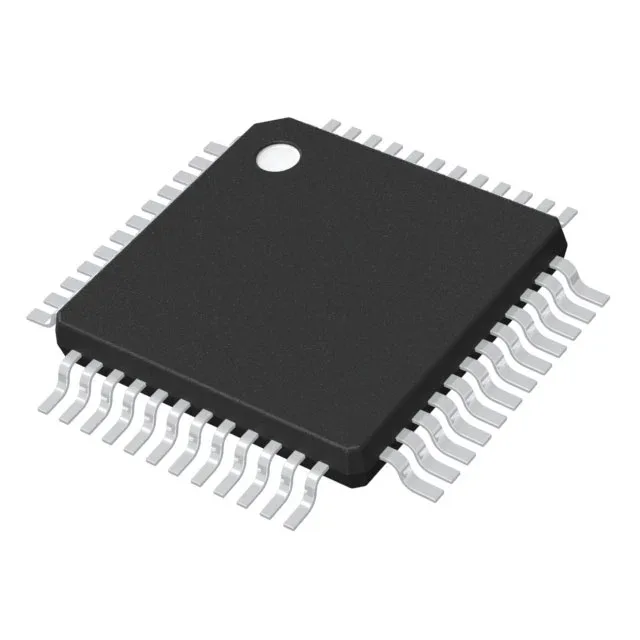
ST STM8S105C6T6TR 8-bit MCU, 32KB Flash, 16 MHz, 48-LQFP
MPNSTM8S105C6T6TR
Active
STMicroelectronics STM8S series, STM8S105C6T6TR, 8-bit STM8 core MCU, 16 MHz, 32 KB Flash, 2 KB RAM, 1 KB EEPROM, 48-LQFP (7x7 mm), -40 to 85°C, 2.95 V to 5.5 V supply.
$3.1200Ref. price · indicative, final on quote
Independent supplier — new & surplus stockAuthenticity-screened · ESD-safe packingListing updated Jul 2026
Specifications
| Parameter | Value |
|---|---|
| Series | STM8S |
| Mounting | Surface Mount |
| Oscillator type | Internal |
| Program memory type | FLASH |
| Voltage - supply (Vcc (Vdd)) | 2.95V ~ 5.5V |
| Operating temperature | -40°C~85°C(TA) |
| Speed | 16MHz |
| Package | Tape & Reel (TR); Cut Tape (CT) |
| RAM size | 2K x 8 |
| Core size | 8-Bit |
| EEPROM size | 1K x 8 |
| Peripherals | Brown-out Detect/Reset, POR, PWM, WDT |
| Connectivity | I²C, IrDA, LINbus, SPI, UART/USART |
| Number of i (O) | 38 |
| Core processor | STM8 |
| Case | 48-LQFP |
| Data converters | A/D 10x10b |
| Program memory size | 32KB (32K x 8) |
Product details
Frequently asked questions
What are the alternatives or equivalent parts for STM8S105C6T6TR?
Within the STM8S family, pin-compatible variants with different Flash and RAM sizes exist (e.g., STM8S105K6 with 32 KB Flash in a 32-pin package, or STM8S105C4 with 16 KB Flash). The evidence does not list a direct second-source from another manufacturer. For a drop-in replacement, stick with the same STM8S105C6 base part number in the 48-LQFP footprint.
Where can I find the STM8S105C6T6TR datasheet?
The datasheet is available from STMicroelectronics' website under the STM8S105x6 product page. It covers electrical characteristics, memory map, peripheral registers, and application notes.
How do I program the STM8S105C6T6TR?
Programming is done via the SWIM (Single Wire Interface Module) debug interface, which uses a single pin for communication. ST offers the ST-Link programmer/debugger that supports SWIM. The internal oscillator means no external clock is needed for programming.