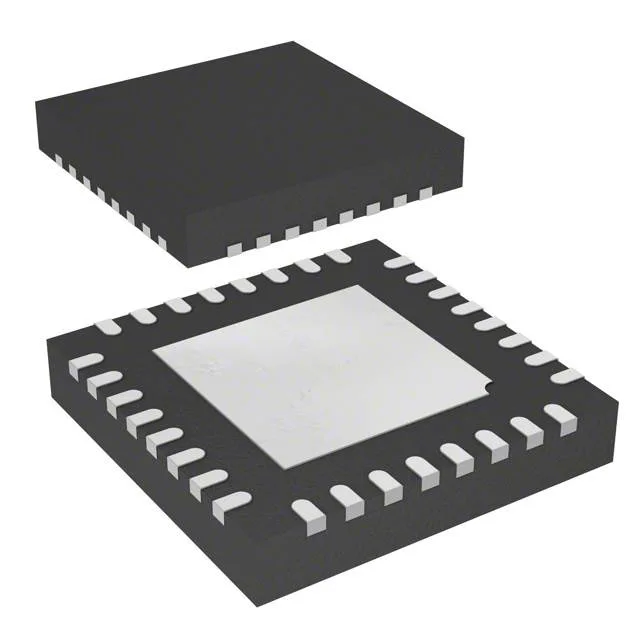
8 KB Flash, 16 MHz — the BOM-fit tier
It runs at 16 MHz and packs 8 KB of Flash program memory, 1 KB of SRAM, and 640 bytes of EEPROM — a memory footprint sized for cost-sensitive control applications like appliance panels, sensor interfaces, and motor-control nodes where a 32-bit ARM core would be overkill and the BOM needs to stay under a dollar fifty.
16 MHz — timing budget for UART and PWM
At 16 MHz the core clock gives a 62.5 ns instruction cycle time. That is fast enough to bit-bang a 115200 baud UART with margin, or generate a 16-bit PWM at 244 Hz resolution. For a 1 MHz PWM output the timer prescaler drops the effective resolution to 16 steps — fine for fan speed or LED dimming, not for servo-loop precision. If you need finer PWM granularity at higher frequencies, step up to the STM8S105 or STM8S207 family with a 24 MHz core.
32-UFQFPN — footprint and thermal
The 32-UFQFPN (5x5 mm) package with exposed pad is the only mechanical option for this order code. The 0.5 mm pitch means a standard 0.3 mm stencil aperture works; no micro-BGA rework needed.
STMicroelectronics lists the STM8S103K3U6TR as an active product. There is no last-time-buy notice and no announced end-of-life. For new designs this means you can commit the BOM line without a near-term obsolescence watch. The STM8S103K3 is a popular density point in the STM8S family, so second-source availability through independent distribution is robust — we source and quote it against an RFQ through our multi-supplier channel.