What this 8-bit MCU brings to a control board
At 16 MHz the STM8 core executes most instructions in one or two clock cycles, so the effective throughput is closer to 16 MIPS for simple register-to-register moves. That is enough headroom for a 10 kHz PID loop with sensor read and PWM update, or for bit-banging a custom serial protocol at 1 Mbps. The internal oscillator trims to ±1% accuracy over temperature, which saves an external crystal in non-critical timing applications.
Memory sizing for firmware and data logging
8 KB of Flash holds a moderate application — think a bootloader plus a state-machine control loop with a few hundred lines of C. The 1 KB SRAM limits buffering; a UART receive ring buffer of 256 bytes plus a 128-byte sensor data array leaves about 640 bytes for stack and variables. The 640 bytes of EEPROM are useful for calibration constants, node ID, or fault logs that survive power loss. If the firmware grows beyond 8 KB, look at the STM8S105 or STM8S207 family members with larger Flash and RAM.
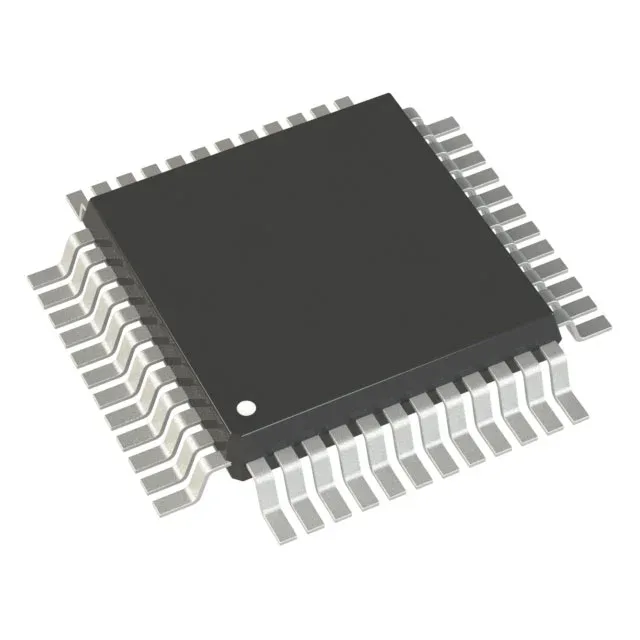
The 32-LQFP package (7x7 mm) is hand-solderable and inspectable, which helps during prototype rework or low-volume production. The wide supply range also helps ride through brown-out conditions common in industrial power rails.
Listed as Active by STMicroelectronics, so there is no imminent EOL risk for new designs.