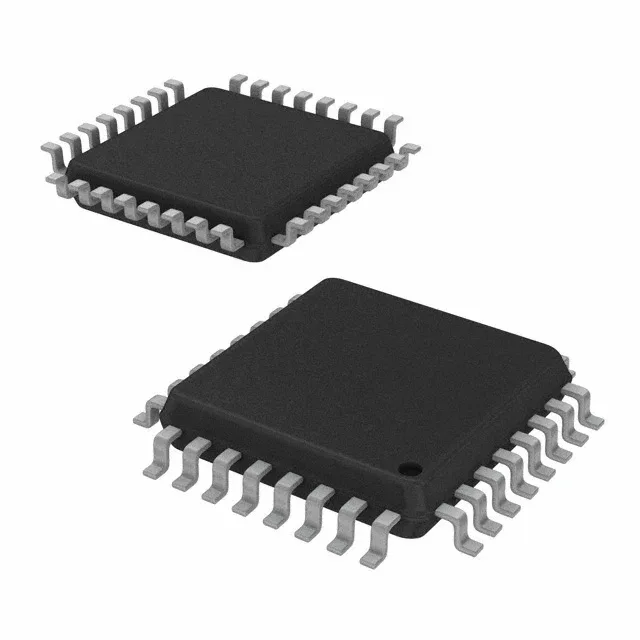
STMicroelectronics STM8L152K6T3 — Microcontrollers & Processors (MCU / MPU / DSP)

STM8L152K6T3 STMicroelectronics 8-bit MCU, 32 KB Flash

MPNSTM8L152K6T3
Active

STMicroelectronics STM8L152K6T3, 8-bit MCU from the STM8L EnergyLite series, 16 MHz core, 32 KB Flash, 2K x 8 RAM, 1K x 8 EEPROM, 32-LQFP, -40 to 125°C.

$1.9845Ref. price · indicative, final on quote
Independent supplier — new & surplus stockAuthenticity-screened · ESD-safe packingListing updated Jul 2026

Specifications

STM8L152K6T3 specifications
ParameterValue
SeriesSTM8L EnergyLite
MountingSurface Mount
Oscillator typeInternal
Program memory typeFLASH
Voltage - supply (Vcc (Vdd))1.8V ~ 3.6V
Operating temperature-40°C~125°C(TA)
Speed16MHz
PackageTray
RAM size2K x 8
Core size8-Bit
EEPROM size1K x 8
PeripheralsBrown-out Detect/Reset, DMA, IR, LCD, POR, PWM, WDT
ConnectivityI²C, IrDA, SPI, UART/USART
Number of i (O)29
Core processorSTM8
Case32-LQFP
Data convertersA/D 21x12b; D/A 1x12b
Program memory size32KB (32K x 8)

Product details

16 MHz core, 32 KB Flash — what this 8-bit MCU is built for

The brown-out detect and POR blocks reduce external supervisor IC cost on the BOM.

21-channel 12-bit ADC and 12-bit DAC — analog integration on an 8-bit budget

The STM8L152K6T3 carries a 12-bit ADC with 21 multiplexed channels and a separate 12-bit DAC. That is more analog channels than most 8-bit MCUs in this Flash-density class, which typically offer 8 to 16 ADC inputs and no DAC. For a design that needs to read multiple sensor voltages (thermistors, potentiometers, current-shunt amps) and output a single analog setpoint or audio waveform, this part saves the cost of an external DAC or an extra ADC mux. The 12-bit resolution on both converters gives 4096 counts — adequate for 0.1% accuracy on a 3.3 V reference after calibration. If your application demands better than 10 effective bits at the ADC sample rate, budget a firmware oversampling loop; the 16 MHz core has headroom for that.

No last-time-buy window to track, no end-of-life notice to plan around. The STM8L EnergyLite family has been a stable offering from ST for over a decade, and the T3 suffix indicates the industrial-temperature variant — not a niche or short-run derivative.

For small-quantity prototyping or production-run replenishment, an RFQ gets you a firm price and lead-time commitment.

Frequently asked questions

What is the difference between STM8L152K6T3 and STM8L151K6T3?

The STM8L152K6T3 includes an integrated LCD driver and a 12-bit DAC, while the STM8L151K6T3 omits both. Otherwise the two are pin-compatible and share the same 16 MHz core, 32 KB Flash, 2K x 8 RAM, and 1K x 8 EEPROM. If your design needs a segment LCD interface or an analog output, the 152 variant is the one; for a pure digital control application the 151 saves a small cost.

Can STM8L152K6T3 be used as a replacement for STM8L152K6?

The STM8L152K6T3 is the industrial-temperature (-40°C to 125°C) variant of the base STM8L152K6. If your application requires the wider temperature grade, the T3 suffix is the correct replacement. Check the package code — both are 32-LQFP — so the footprint matches.

How to program STM8L152K6T3 with ST-Link?

The STM8L152K6T3 uses the standard STM8 SWIM (Single Wire Interface Module) debug/programming protocol, which is supported by all ST-Link/V2 and ST-Link/V3 programmers. ST Visual Programmer (STVP) or the STM8 CubeProgrammer tool handles the flash erase and write.

What development tools support STM8L152K6T3?

STMicroelectronics provides the STM8CubeMX graphical configuration tool and the STM8 SPL (Standard Peripheral Library) for code development. The Cosmic and IAR Embedded Workbench for STM8 compilers are the primary toolchains. For debugging and programming, the ST-Link/V2 or ST-Link/V3 probe works with the SWIM interface. Open-source alternatives include SDCC (Small Device C Compiler) with the stm8flash programming utility.