16 MHz 8-bit core with 32 KB Flash — memory sizing for a single-chip sensor node
That memory split — particularly the separate EEPROM block — means calibration constants, node addresses, or boot parameters live in nonvolatile storage without wearing the Flash array or requiring an external serial EEPROM. The 2 KB RAM is the working-data ceiling; for a typical sensor node running a 10 ms control loop with a 256-byte ADC buffer, you have room left for a modest protocol stack. The 22-channel 12-bit ADC and single 12-bit DAC cover analog front-end needs without external converters.
Temperature range and supply — rated for the industrial floor
Brown-out detect and POR are integrated, so the reset supervisor is on-chip — one less external component to budget.
Connectivity and peripherals — what the serial bus map looks like
The UART handles RS-232 or RS-485 with an external transceiver; the SPI can talk to external Flash or a display controller at the 16 MHz core speed. IrDA is less common on 8-bit parts — useful if the design needs an optical isolation barrier or a wireless IR link. The 30 I/O pins in the 32-UFQFN package leave two pins for the external oscillator (though the internal oscillator is available) and the rest for GPIO and peripheral functions. DMA is listed among the peripherals, which offloads data transfers from the core.
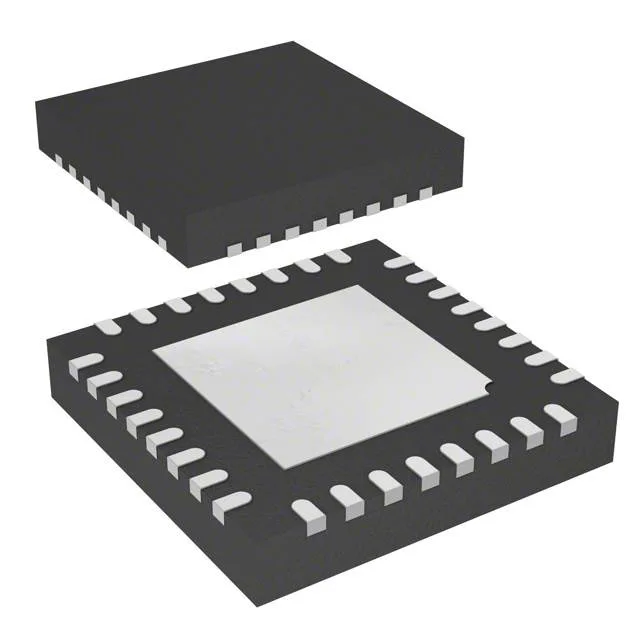
Package and footprint — 32-UFQFN with exposed pad
The package is a 32-lead UFQFN with an exposed pad (5x5 mm body).