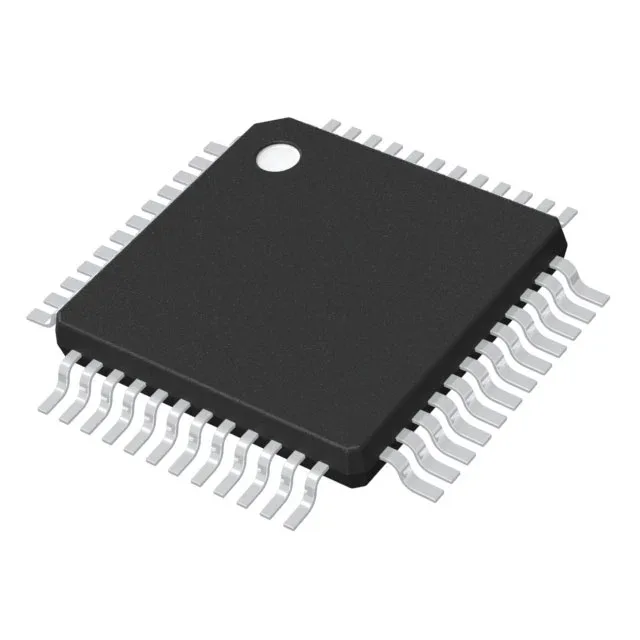
STMicroelectronics STM8L151C8T3 — Microcontrollers & Processors (MCU / MPU / DSP)

STMicroelectronics STM8L151C8T3 8-bit MCU, 16 MHz

MPNSTM8L151C8T3
Active

STMicroelectronics STM8L EnergyLite series, STM8L151C8T3, 8-Bit MCU, 16MHz, 64KB (64K x 8) FLASH, 4K x 8 RAM, 2K x 8 EEPROM, 48-LQFP, -40°C ~ 125°C.

$4.2500Ref. price · indicative, final on quote
Independent supplier — new & surplus stockAuthenticity-screened · ESD-safe packingListing updated Jul 2026

Specifications

STM8L151C8T3 specifications
ParameterValue
SeriesSTM8L EnergyLite
MountingSurface Mount
Oscillator typeInternal
Program memory typeFLASH
Voltage - supply (Vcc (Vdd))1.8V ~ 3.6V
Operating temperature-40°C~125°C(TA)
Speed16MHz
PackageTray
RAM size4K x 8
Core size8-Bit
EEPROM size2K x 8
PeripheralsBrown-out Detect/Reset, DMA, IR, POR, PWM, WDT
ConnectivityI²C, IrDA, SPI, UART/USART
Number of i (O)41
Core processorSTM8
Case48-LQFP
Data convertersA/D 25x12b; D/A 2x12b
Program memory size64KB (64K x 8)

Product details

16 MHz 8-bit core with 64 KB Flash — the EnergyLite sweet spot

What the 16 MHz clock and 64 kB Flash mean for your BOM

The 64 KB Flash is a mid-range density that can hold a modest RTOS, a Bluetooth or sub-GHz stack, and application code for a typical IoT endpoint. For designs that need more program space, the STM8L152C8T3 is a sibling with a built-in LCD segment driver — a difference to weigh if your BOM already carries an external display controller.

With 25 multiplexed 12-bit ADC channels and two 12-bit DAC outputs, this MCU can handle multi-sensor acquisition and generate analog control signals without external converters. The ADC channel count is unusually high for an 8-bit MCU — enough to monitor a bank of thermistors, strain gauges, or potentiometers in a single device. The DACs are useful for set-point generation in closed-loop systems or for producing analog waveforms in signal-conditioning stages.

Package and mounting: 48-LQFP (7x7 mm)

The LQFP package is rework-friendly with a standard hot-air profile, and the exposed pad (if present on the variant) aids thermal dissipation when running continuous ADC conversions or driving multiple outputs.

Frequently asked questions

What is the difference between STM8L151C8T3 and STM8L152C8T3?

The primary difference is that the STM8L152C8T3 integrates an LCD segment driver, while the STM8L151C8T3 does not. Both share the same core, memory sizes (64 KB Flash, 4 KB RAM, 2 KB EEPROM), analog peripherals (25x12-bit ADC, 2x12-bit DAC), temperature range, and package. Choose the STM8L152C8T3 if your design drives a segmented LCD directly; otherwise, the STM8L151C8T3 is the cost-optimized choice.

Can I program STM8L151C8T3 with ST Visual Programmer?

Yes, ST Visual Programmer (STVP) supports the STM8L151C8T3 via the ST-Link/V2 or ST-Link/V3 debugger/programmer. The SWIM (Single Wire Interface Module) protocol used by ST-Link tools is the standard programming and debugging interface for this MCU. Connect the SWIM pin, ground, and supply, and STVP will recognize the device.