The 4 KB of on-chip Flash and 1.5 KB of RAM set a tight memory budget — this part is for lightweight control loops, sensor polling, or simple interface bridging, not data logging or complex protocol stacks.
The 16 MHz core speed is typical for 8-bit MCUs in this class, but the 1.65 V minimum supply is lower than many competitors, which allows the part to run directly from a nearly-discharged Li-ion cell (down to about 3.0 V open-circuit) or a pair of alkaline batteries. The internal oscillator saves the cost and board area of an external crystal, though accuracy will drift with temperature — fine for UART timing or PWM dimming, not for a precision real-time clock. The 4 KB Flash sector size is 64 bytes, so wear-leveling overhead is negligible if you store calibration constants.
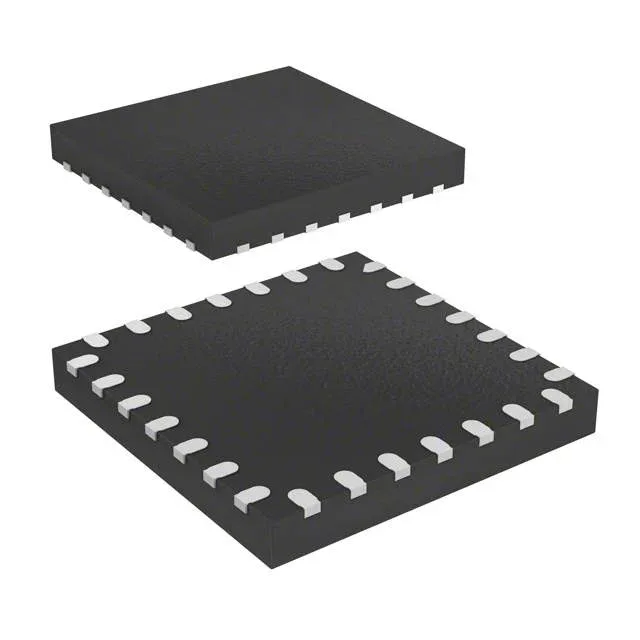
Package and footprint: 28-UFQFPN (4x4 mm)
The 26 I/O pins are enough for a keypad matrix, a small character LCD, or a handful of sensors and actuators, but not for a large parallel bus.
That's enough for communicating with a simple external ADC, an EEPROM, or a radio module. The PWM channels can drive an LED or a small DC motor through a MOSFET. No CAN, no USB, no DAC — if your design needs those, you are looking at a different part.
For a repair bench, an active part is always easier to source than an obsolete one — no digging through surplus channels or paying broker premiums.