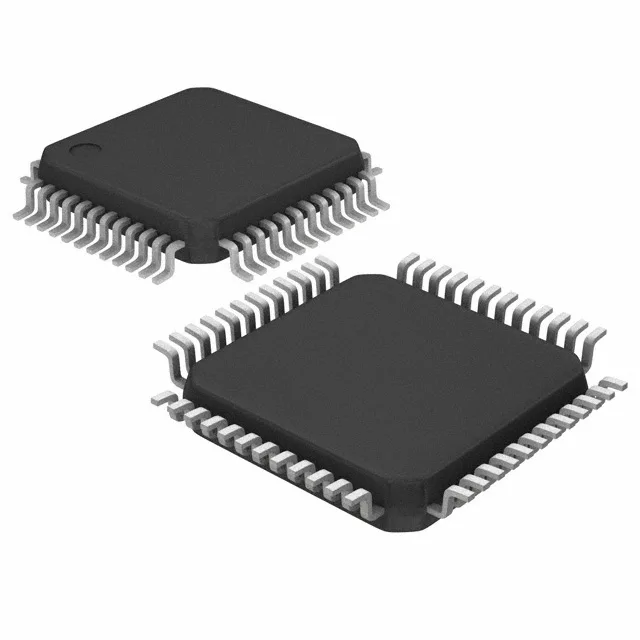
150°C junction — the spec that opens the engine bay
The STM8AF62A8TDX is an 8-bit automotive MCU from STMicroelectronics built on the STM8A core, rated for continuous operation up to 150°C ambient. That temperature grade is the headline reason to pick this part over a commercial 85°C or industrial 105°C MCU — it survives inside an engine control module, transmission controller, or exhaust aftertreatment ECU where the PCB sees sustained heat soak. AEC-Q100 qualification backs the reliability story with the full automotive stress flow: extended temperature cycling, high-temperature operating life, and ESD robustness. The 128 KB Flash and 6 KB RAM are sized for body-control firmware — LIN master stacks, window lift logic, wiper control, and the diagnostic UDS layer all fit without squeezing. The internal oscillator means you can boot without an external crystal, though the 24 MHz core clock needs the Flash wait state configured correctly in the first few lines of firmware.
For production builds already using this MCU, the NRND status flags a need to review the LTB (last-time-buy) horizon with your supply chain team. The official successor path within the STM8A family is the STM8AF62A8TCX variant, which shares the same 48-LQFP footprint and peripheral set but carries a different ordering code — verify the exact suffix match against your BOM before swapping. No pinout change is expected, but a full qualification re-test on the new date code lot is standard practice for automotive programs.
Peripheral set and connectivity — what is on the die
The STM8AF62A8TDX integrates a 10-channel 10-bit ADC, two UART/USART modules, SPI, I²C, and a LIN controller. The LIN interface is the key differentiator for automotive body electronics — it handles the local interconnect network protocol without an external transceiver IC in the MCU itself (the physical layer transceiver is still needed on the board). PWM outputs from the timer block drive H-bridge pre-drivers for DC motor control. Brown-out reset and programmable watchdog are built in, so a window lifter module or sunroof controller can run without an external supervisor IC. The 38 general-purpose I/O pins in the 48-LQFP package leave enough headroom for a keypad matrix, LED indicators, and a few sensor inputs alongside the communication buses.