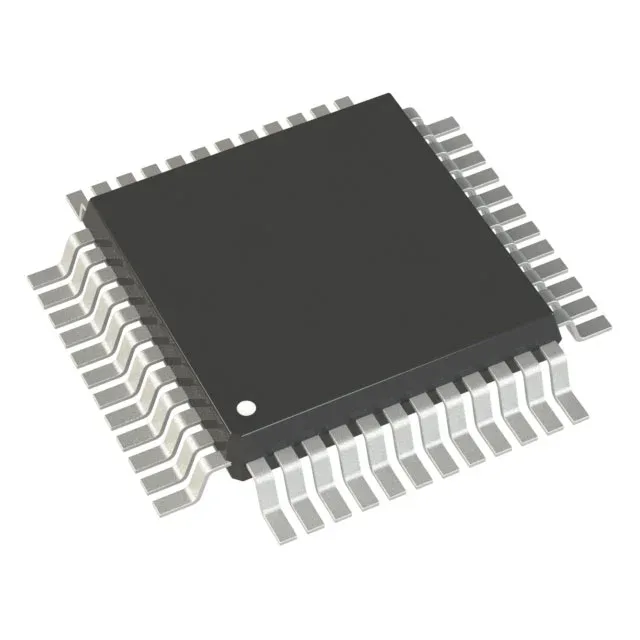
16 MHz core — throughput for real-time control
The 16 MHz clock rate is the maximum for this STM8A core. At this speed, the MCU can execute most single-cycle instructions, giving it enough headroom for tasks like PWM generation at automotive-relevant frequencies, LINbus message handling, and 10-bit ADC conversions at 7 channels without stalling the control loop.
The 32 KB Flash (32K x 8) holds the application firmware. For a typical automotive body-control function — door module, seat adjuster, or HVAC actuator — this is adequate for the main loop, interrupt handlers, and a modest bootloader. The 2K x 8 RAM supports a few hundred bytes of stack and global variables; the 1K x 8 EEPROM stores calibration constants and fault codes without needing external non-volatile memory. The EEPROM endurance is rated for the STM8A family's standard 100k write cycles, sufficient for wear-leveled parameter storage over a vehicle's lifetime.
NRND — planning for the last-time buy
This means STMicroelectronics will continue to manufacture the part for existing production programs, but new designs should target a replacement. Procurement teams should secure sufficient inventory through the LTB or qualify a pin-compatible second source within the STM8A family.
Peripherals and connectivity for automotive networks
The 25 I/O lines, brown-out detect/reset, POR, PWM, and watchdog timer (WDT) are standard for body-control applications. The 7-channel 10-bit ADC handles analog sensor inputs — temperature, position, or voltage monitoring — without an external converter.