150°C junction rating — the under-hood enabler
The STM8AF6246ITDX: That 150°C ceiling is the spec that separates it from industrial-grade parts — it keeps the core, Flash, and peripherals alive in engine-bay or exhaust-adjacent environments where ambient temps push past 105°C. The 16 MHz core speed, 16 KB of program Flash, 2 KB RAM, and 512 bytes of EEPROM give it enough headroom for a single LIN node, a small BLDC motor controller, or a sensor fusion hub that needs to log calibration data across power cycles.
NRND — plan the last-time-buy now
This is the formal signal from ST that the part is in its phase-out window — a last-time-buy (LTB) date has been or will be set, after which no further factory orders are accepted. For a production BOM that already qualifies this MCU, the immediate action is to secure enough lifetime-buy stock to cover the remaining build horizon, or to begin a qualification cycle on a pin-compatible successor. Because the part is NRND, new designs should not start with this order code; the engineering team should target a current-production STM8A variant instead.
Peripheral set for body-electronics and LIN nodes
The STM8AF6246ITDX integrates a 7-channel 10-bit SAR ADC, a full set of standard timers with PWM, a watchdog timer, brown-out detect and POR, plus connectivity for I²C, LINbus, SPI, and UART/USART. The LIN interface is the key differentiator for automotive body electronics — it allows the MCU to sit on a LIN bus as a slave node for window lifts, mirror adjust, seat memory, or HVAC flap control. The 25 available I/O in the 32-LQFP package leave enough pins for local sensor inputs and a small LED or relay driver array without needing a port expander.
Supply range and oscillator — single-rail simplicity
For precision timing — CAN or LIN bit-timing, for instance — an external clock source can still be fed in, but the internal RC is adequate for most body-control and sensor-fusion tasks at 16 MHz.
32-LQFP footprint — layout and rework notes
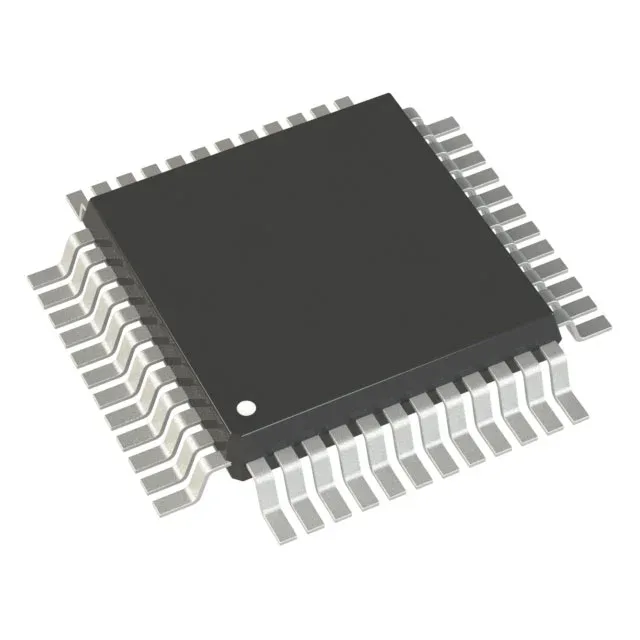
The STM8AF6246ITDX is supplied in a 32-LQFP package with a 7x7 mm body (supplier device package 32-LQFP 7x7). The 0.8 mm pitch is hand-solderable with a fine-tip iron, but for production volume, reflow profiling per JEDEC MSL level (verify on the reel label) is standard. The exposed pad, if present on this variant, should be stitched to the ground plane with at least four vias to aid thermal transfer — the 150°C junction rating assumes the board can pull heat away. Surface-mount only; no through-hole equivalent exists.