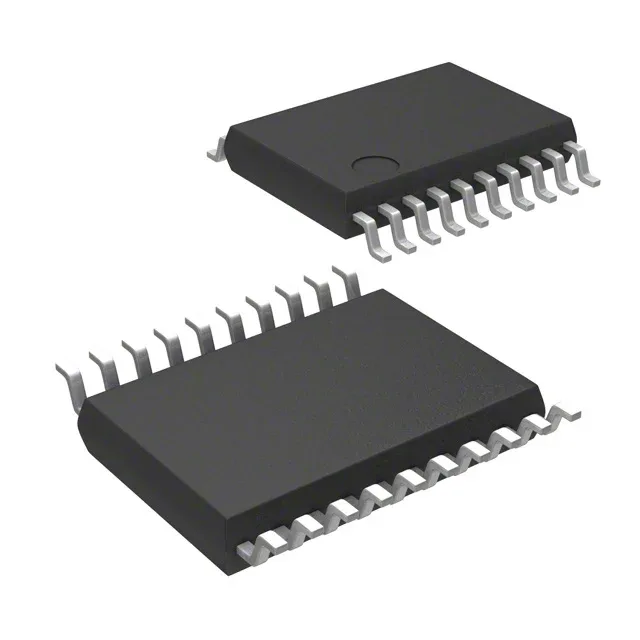
It runs at up to 16 MHz from an internal oscillator, with 4 KB of Flash program memory, 1K x 8 of RAM, and 640 x 8 of EEPROM for data storage. The part is designed for surface-mount assembly in a 20-TSSOP package and operates across a -40°C to 150°C temperature range — wide enough for under-hood automotive environments or industrial enclosures where standard 85°C parts would not survive.
16 MHz core — enough for body-control and LIN nodes
The 16 MHz clock rate on the STM8A core is modest by today's standards, but it is a deliberate fit for low-cost, low-complexity automotive tasks: reading a few sensors, driving a relay or PWM output, and talking over LINbus or I²C. The 4 KB Flash and 1K x 8 RAM mean the firmware must be lean — think window-lift logic, wiper timing, or a simple LIN slave node. The 640 x 8 EEPROM provides non-volatile storage for calibration or fault codes without external memory.
NRND — plan your BOM accordingly
This means STMicroelectronics still manufactures it for existing production programs, but the part is on a path toward end-of-life. For new designs, ST recommends evaluating a current-production alternative within the STM8A family — the 20-TSSOP pinout is shared across several density options, so a pin-compatible upgrade with more Flash or RAM may be available without a board spin. For ongoing production, secure your last-time-buy quantities or qualify a second source through independent distribution.
AEC-Q100 and 150°C — the reliability envelope
The 150°C upper limit allows placement near an engine block, exhaust manifold, or in a sealed actuator housing where ambient temperatures exceed 105°C.
Peripherals and connectivity for automotive sub-systems
Connectivity covers I²C, LINbus, SPI, and UART/USART, so the MCU can serve as a LIN slave node, communicate with a central ECU over SPI, or log data over UART. The 16 available I/O lines in the 20-TSSOP package leave room for a few switches, LEDs, and a serial interface in a compact footprint.