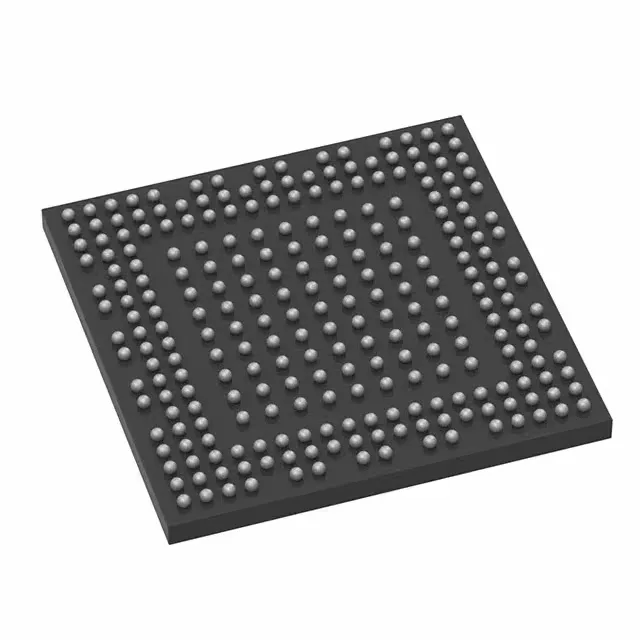
Dual-core architecture: application processor plus real-time coprocessor
The STM32MP157FAD1 integrates a dual ARM Cortex-A7 core running at 800 MHz for the application operating system alongside a Cortex-M4 core at 209 MHz for deterministic real-time control. This asymmetric multiprocessing arrangement lets a single chip host both Linux and a bare-metal or RTOS control loop without an external companion microcontroller. The Cortex-A7 cluster handles the rich user interface and network stack; the Cortex-M4 manages time-critical I/O such as motor commutation, sensor polling, or protocol timing. The two cores share the memory subsystem through the internal bus matrix, with the M4 accessing its own tightly-coupled memory for deterministic latency.
Memory controller flexibility for cost-optimised BOM
The integrated memory controller supports DDR3, DDR3L, LPDDR2, and LPDDR3 SDRAM. This range lets the designer choose between commodity DDR3 for lowest cost, DDR3L for reduced power, or LPDDR2/LPDDR3 for compact mobile-grade memory in space-constrained designs. The controller handles the refresh and timing differences transparently. A 257-ball TFBGA in a 10x10 mm array places the memory interface signals on the outer two ball rows for straightforward PCB fan-out. The 0.50 mm ball pitch demands a four-layer board minimum for signal integrity on the DDR bus; the inner balls carry the core supply and ground returns.
Connectivity suite: dual Ethernet and multiple USB ports
The part carries two USB 2.0 host/device ports and three USB 2.0 OTG interfaces with integrated PHY. This allows simultaneous connection to a USB keyboard, a storage device, and an OTG peripheral without external hub chips. The OTG PHY handles the negotiation and VBUS switching on-chip. Ethernet connectivity includes a 10/100 Mbps MAC and a Gigabit Ethernet MAC. The GbE port supports industrial Ethernet protocols such as EtherCAT or PROFINET when paired with an external PHY; the 10/100 port serves as a service or management interface. Both MACs include the DMA engine for zero-copy packet transfer. The SDIO interface supports both SD cards and eMMC devices for boot or bulk storage. The SPDIF transmitter routes digital audio directly to an external DAC or amplifier.
Industrial temperature range and security foundation
Rated for -20°C to 105°C junction temperature, the STM32MP157FAD1 suits factory-floor controllers, outdoor gateways, and automotive infotainment that see elevated ambient temperatures. The 105°C ceiling provides margin above the 85°C industrial standard for enclosures with limited airflow. ARM TrustZone technology provides hardware-enforced isolation between a secure world (boot loader, key storage, firmware update) and a normal world (application OS, user code). The secure boot chain verifies each stage before execution, preventing unauthorised firmware from running.
Graphics and display pipeline
Hardware graphics acceleration is built in, offloading 2D composition and rotation from the Cortex-A7 cores. The LCD interface supports parallel RGB displays up to WXGA resolution; the HDMI-CEC controller handles consumer electronics control signalling for HDMI-connected displays.