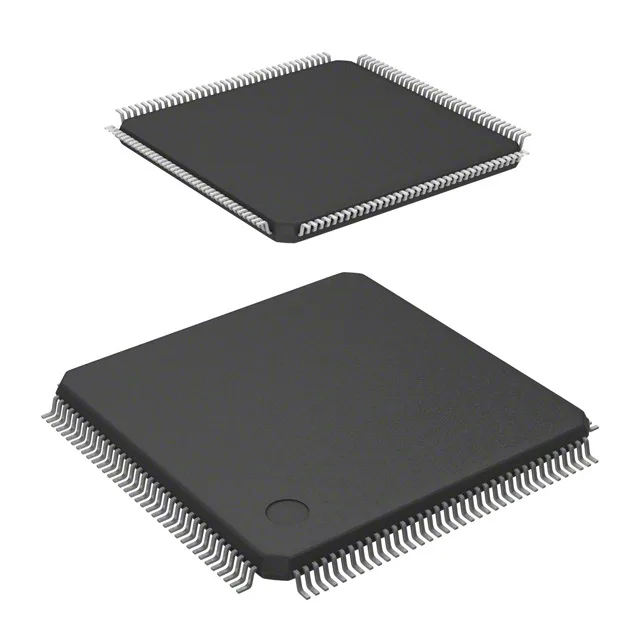
STMicroelectronics STM32L4R5ZIT6 — Microcontrollers & Processors (MCU / MPU / DSP)

STM32L4R5ZIT6 STM32L4R MCU, ARM Cortex-M4 120MHz, 2MB Flash

MPNSTM32L4R5ZIT6
Active

STMicroelectronics STM32L4R series, STM32L4R5ZIT6, 32-bit ARM Cortex-M4 MCU, 120 MHz, 2 MB Flash, 640 KB SRAM, 115 I/O, 144-LQFP, -40°C to 85°C.

$16.11088Ref. price · indicative, final on quote
Packaging144-LQFP
RoHSROHS3 Compliant
SeriesSTM32L4R
Independent supplier — new & surplus stockAuthenticity-screened · ESD-safe packingListing updated Aug 2026

Specifications

STM32L4R5ZIT6 specifications
ParameterValue
SeriesSTM32L4R
MountingSurface Mount
Oscillator typeInternal
Program memory typeFLASH
Voltage - supply (Vcc (Vdd))1.71V ~ 3.6V
Operating temperature-40°C ~ 85°C (TA)
Speed120MHz
PackageTray
RAM size640K x 8
Core size32-Bit Single-Core
PeripheralsBrown-out Detect/Reset, DMA, POR, PWM, WDT
ConnectivityCANbus, EBI/EMI, I²C, IrDA, LINbus, MMC/SD, SAI, SPI, UART/USART, USB OTG
Number of i (O)115
Core processorARM® Cortex®-M4
Case144-LQFP
Data convertersA/D 16x12b; D/A 2x12b
Program memory size2MB (2M x 8)

Product details

The 115 I/O pins in a 144-LQFP package give it the connectivity headroom for sensor arrays, external memory buses, or parallel display interfaces.

Connectivity and data converters for system integration

The STM32L4R5ZIT6 integrates a broad set of wired interfaces: CANbus, I²C, IrDA, LINbus, SAI, SPI, UART/USART, and USB OTG.

Package and footprint — 144-LQFP (20x20 mm)

It is surface-mount and ships in tray form.

Frequently asked questions

What is STM32L4R5ZIT6's listed speed?

The core is an ARM Cortex-M4 running at 120 MHz. At this clock rate, the Flash requires zero wait states for most operations; the ART Accelerator handles instruction prefetch to keep the pipeline fed.

What is the closest functional second-source for STM32L4R5ZIT6?

The STM32L151CBU6A is a lower-performance sibling — a Cortex-M3 at 32 MHz with 37 I/O and 128 KB Flash. It is not a pin-compatible or performance-equivalent second-source. For a direct STM32L4R-series alternate, look at the STM32L4R5xI density variants in the same 144-LQFP footprint.

How to program STM32L4R5ZIT6?

Programming is done via the SWD (Serial Wire Debug) interface using a standard ST-Link/V2 or J-Link probe. The device boots from internal Flash with BOOT0 strapped low. The internal oscillator is enabled by default, so no external crystal is required for initial programming.

What development board supports STM32L4R5ZIT6?

STMicroelectronics offers the NUCLEO-L4R5ZI and STM32L4R5I-DISCO discovery kit for this MCU family. Both boards expose the full I/O and include an integrated ST-Link debugger.