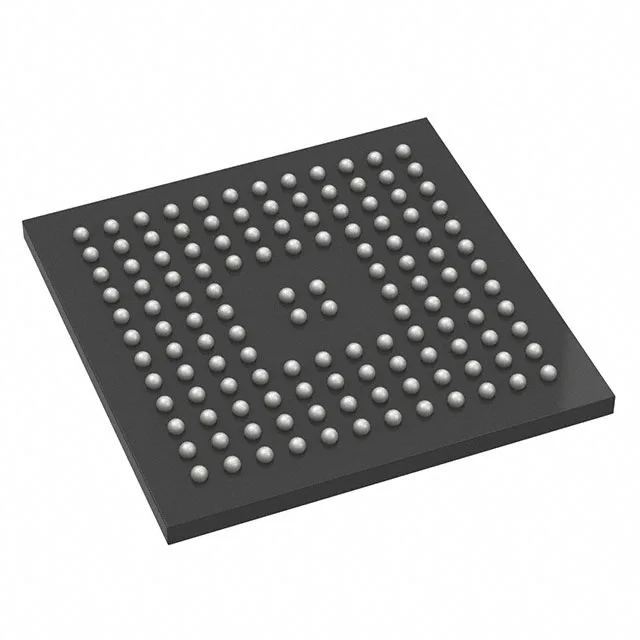
This combination targets applications that need both signal-processing throughput and a large memory map for complex firmware, GUI frame buffers, or OTA update staging — think industrial HMI panels, advanced sensor fusion nodes, and battery-operated medical peripherals. The 640 KB SRAM is notably generous for a Cortex-M4 in this power tier; it reduces the need for external memory in designs that buffer camera frames, audio streams, or large telemetry logs. The 1 MB Flash supports multi-image bootloaders and field-upgradeable firmware without squeezing code into tight sectors.
132-UFBGA 7x7 mm — footprint decisions for the layout engineer
The STM32L4R5QGI6TR comes in a 132-ball Ultra-Fine-Pitch BGA (UFBGA) measuring 7x7 mm. Surface-mount assembly with a 132-UFBGA means the board house needs a solder-paste stencil matched to the 0.5 mm or finer ball pitch.
The base product number is STM32L4R5, part of the STM32L4 series which shares a common pinout across density options. If a future design requires more Flash or RAM, pin-compatible siblings in the same family are available without a PCB spin.