What this STM32L4P5CGT6 brings to a mixed-signal control board
It belongs to the STM32L4 ultra-low-power series, designed for applications that balance processing throughput with energy efficiency — think industrial sensor nodes, portable medical devices, metering, and IoT gateways that run on battery or energy-harvesting supplies.
The 120 MHz ARM Cortex-M4 core includes a single-precision floating-point unit, so control loops with PID or sensor fusion math run without software emulation overhead. For firmware bring-up, the internal oscillator gets you running immediately, but hitting the full 120 MHz requires setting one flash wait state before raising the core clock — skip that step and the first branch instruction hard-faults. The 320 KB SRAM gives enough headroom for double-buffered graphics on a small LCD, audio buffers, or multiple protocol stacks without external memory. With 1 MB of Flash, you can stage over-the-air firmware updates and still leave room for a full RTOS image.
Connectivity and peripherals for a single-chip system
This MCU integrates USB OTG for host or device mode, CANbus for industrial networks, multiple I²C and SPI buses for sensor arrays, and a full set of UART/USART ports with IrDA and LIN support. The EBI/EMI interface can drive external parallel memory or displays, and the SAI peripheral handles I²S audio. On the analog side, there are sixteen 12-bit ADC channels and two 12-bit DACs, enough for multi-channel data acquisition without external converters. The LCD controller drives glass displays directly, saving a separate driver IC on metering and control panels.
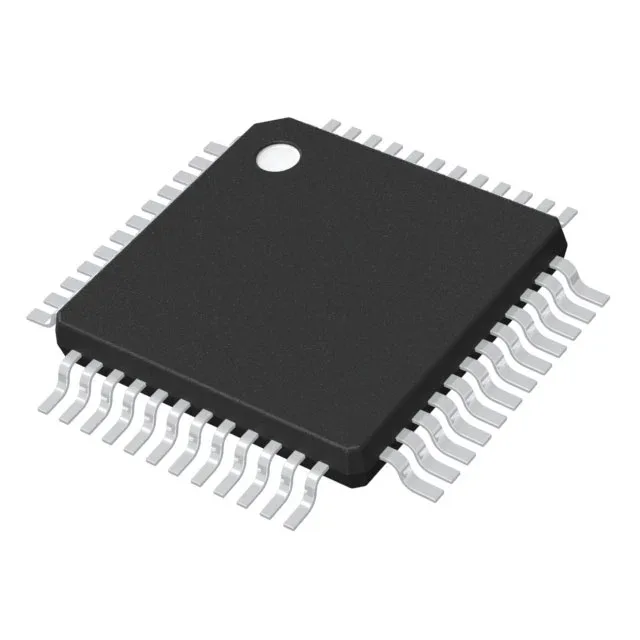
No exposed thermal pad here — dissipation goes through the leads, so keep the ambient airflow in mind if the core runs sustained DSP loads. The 0.5 mm pitch means a standard 0.3 mm tip on the rework station works for hand-soldering prototypes, but use a hot-air station for removal to avoid lifting pads.
The base product number STM32L4P5 covers the full density and package options in the series, so if the 48-LQFP footprint is tight, the 64-pin or 100-pin variants share the same peripheral set and code base.