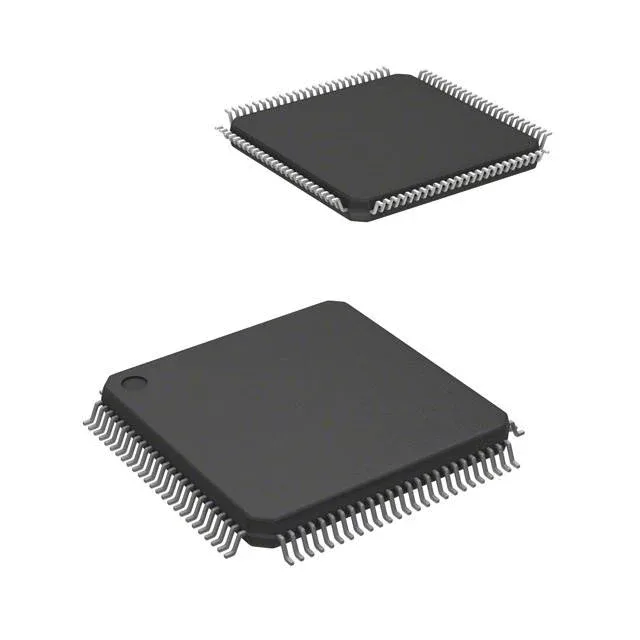
80 MHz Cortex-M4 with FPU — what the core brings
The STM32L496VET6: The 80 MHz ceiling is the practical limit for active compute tasks while staying inside the STM32L4 power budget — you get the M4's signal-processing throughput without the thermal overhead of a higher-clocked part. For a firmware engineer, this means the part can run a real-time control loop alongside an FFT or a sensor fusion algorithm without dropping into a higher power mode.
512 KB Flash and 320 KB SRAM — sizing the firmware and data buffers
The Flash is enough for a full RTOS, a TCP/IP stack, a GUI library, and application code; the SRAM — unusually large for a 512 KB Flash part — can hold a full frame buffer for a QVGA display or a large audio buffer without external memory. The 320 KB SRAM also supports dual-bank firmware updates: one bank active, one bank receiving an OTA image, with room left for runtime data.
Supply range and power flexibility
The lower end at 1.71 V is particularly useful for battery-powered designs that need to run down to near-empty cells. The internal brown-out detect/reset (BOR) is included in the peripheral set, so you can set a voltage threshold to trigger a safe shutdown before the supply drops below the minimum operating level.
I/O and connectivity — what you can hang off the 100-pin LQFP
The connectivity list includes CANbus, I²C, SPI, QSPI, SAI (for audio), USB OTG, and an MMC/SD card interface. The QSPI is the fast lane for external Flash or RAM, and the EBI/EMI can connect to an external SRAM or NOR Flash if the on-chip 320 KB SRAM isn't enough.