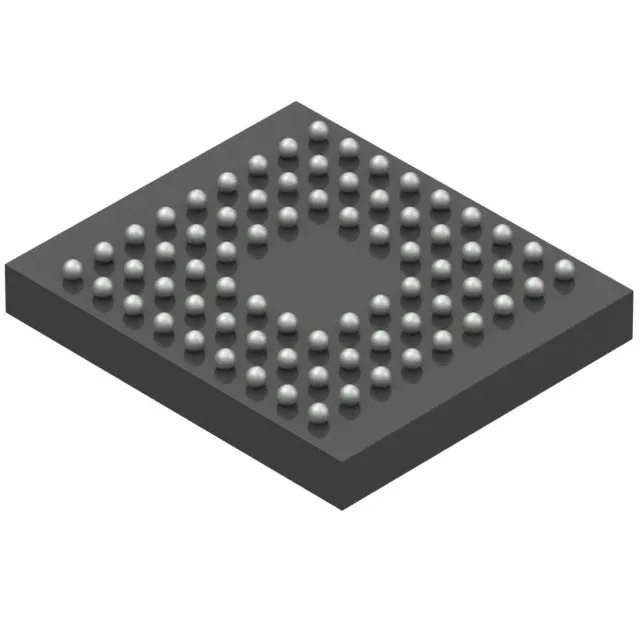
Cortex-M4 at 80 MHz — the throughput ceiling for signal-chain and control-loop tasks
The STM32L486JGY6TR is an STM32L4-series 32-bit MCU built around an ARM Cortex-M4 core clocked at 80 MHz. That clock rate, combined with the single-cycle multiply-accumulate and floating-point unit, sets the compute ceiling for real-time signal processing — think sensor fusion, motor current loops, or audio front-ends where the math must finish before the next sample arrives. With 1 MB of on-chip Flash and 128 KB of SRAM, this part carries enough code and data space for a full protocol stack (USB, CAN, a TCP/IP offload) plus the application layer, without external memory. The 57 I/O lines in the 72-WLCSP package give the layout engineer enough fan-out for a parallel display bus or a bank of sensors.
Connectivity and peripheral mix — BOM consolidation in a single chip
The peripheral set includes CANbus, USB OTG, QSPI, SAI (serial audio interface), SWPMI (single-wire protocol master interface), plus the usual I²C, SPI, UART/USART, and IrDA. For a system architect, this means a single MCU can handle the fieldbus gateway (CAN), the human-machine interface (USB), and the audio codec (SAI) without glue logic. The 16-channel 12-bit ADC and dual 12-bit DAC cover analog front-end tasks — three-phase current sensing, battery voltage monitoring, or analog output generation. On-chip peripherals include a DMA controller, a PWM timer, a brown-out detect/reset, and an LCD driver. The DMA offloads peripheral-to-memory transfers (ADC results, SPI data) so the core stays free for control math; the LCD segment driver can run a small character display directly from the MCU pins.
Supply voltage and temperature grade — single-rail operation in industrial enclosures
The 72-WLCSP package measures 4.41 x 3.76 mm — the smallest footprint in the STM32L4 series. For a PCB layout engineer, this means the MCU fits into a space-constrained design (wearable, sensor node, handheld probe) but demands a controlled solder-paste stencil and X-ray inspection for void-free ball attach.
For a BOM cost engineer, this removes the single-source risk flag that triggers a second-source qualification project. No additional compliance documentation (REACH, UL, IEC) is listed in the product record — the ROHS3 statement is the standard environmental compliance for this class of IC.
Sourcing posture — quoted to order, no stock-holding claim
This MCU is sourced through independent and franchised distribution channels.