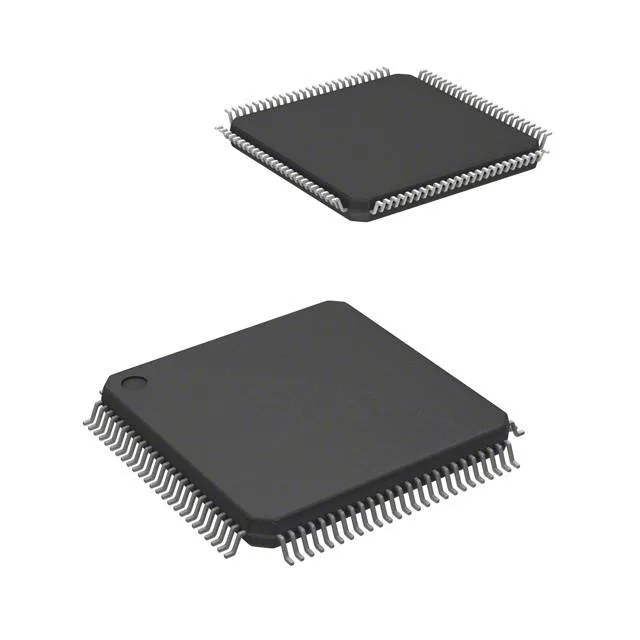
It packs 512 KB of Flash and 128 KB of SRAM, enough for a real-time control loop, a modest GUI frame buffer, or an OTA staging area without external memory. The 100-LQFP package (14x14 mm) gives access to 82 I/O lines, which is generous for a mid-density LQFP — you can hang a parallel LCD, a QSPI NOR Flash, and a CAN transceiver without multiplexing the bus. The 12-bit ADC array (16 channels) and dual 12-bit DAC cover most mixed-signal needs in industrial sensor nodes or portable instrumentation. The internal oscillator trims the BOM by one crystal for UART baud-rate generation, though the USB and CAN blocks still benefit from an external resonator for jitter margin.
The 80 MHz core speed, combined with the single-cycle multiply and hardware FPU, lets this MCU run a sensor-fusion algorithm or a digital filter at sample rates that a Cortex-M3 at 32 MHz (like the STM32L151CBU6A) would struggle with. The STM32L151CBU6A tops out at 32 MHz and lacks an FPU — if your application does floating-point math in the control loop, the STM32L476VET6 saves you the code size and cycle overhead of software emulation. Flash wait states matter at this clock: the STM32L4 prefetch buffer and ART Accelerator keep zero-wait execution from Flash at 80 MHz, so the headline speed is real in typical code — not a theoretical burst figure. That matters when sizing the firmware image and the interrupt latency budget.
ST continues to manufacture the STM32L4 series as a mainstream ultra-low-power platform, so the risk of a surprise allocation or obsolescence-driven redesign is low for the foreseeable future. For dual-sourcing resilience, the STM32L476RET6 (same die, 64-pin LQFP) is a pin-compatible drop-in if your board layout can tolerate the smaller footprint — but the VET6 variant with 100 pins and 82 I/O is the one to qualify when you need the full peripheral set and GPIO count. No direct second-source from another manufacturer exists; the STM32L4 architecture is proprietary to ST.
Design-in checklist for the 100-LQFP build
The exposed pad is not present — all thermal dissipation goes through the leads, so keep the ambient airflow above 0.5 m/s if the core runs continuous FPU or ADC conversions near 85°C. Supply decoupling: one 100 nF ceramic per VDD/VSS pair, plus a 4.7 µF bulk on the main 3.3 V rail. The internal oscillator is rated over the full temperature range, but for USB or CAN operation an external 8 MHz crystal is recommended to meet the ±0.25% bit-rate tolerance. The LCD controller drives up to 8x40 segments directly — no external charge pump needed for typical glass panels.