ARM Cortex-M4 at 80 MHz — what the core clock buys you
The Cortex-M4 includes a single-precision FPU and DSP instructions, so it handles FFTs or filter math in firmware rather than needing an external DSP.
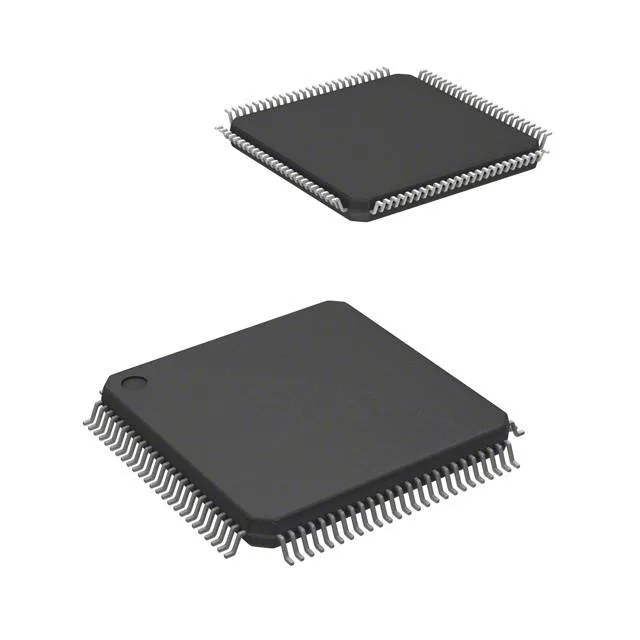
STMicroelectronics STM32L4 series STM32L475VCT6, ARM Cortex-M4 32-bit MCU, 80 MHz, 256 KB Flash, 128 KB SRAM, 82 I/O, 1.71 V to 3.6 V, -40°C to 85°C, 100-LQFP (14x14 mm), Tray.
| Parameter | Value |
|---|---|
| Series | STM32L4 |
| Mounting | Surface Mount |
| Oscillator type | Internal |
| Program memory type | FLASH |
| Voltage - supply (Vcc (Vdd)) | 1.71V ~ 3.6V |
| Operating temperature | -40°C ~ 85°C (TA) |
| Speed | 80MHz |
| Package | Tray |
| RAM size | 128K x 8 |
| Core size | 32-Bit Single-Core |
| Peripherals | Brown-out Detect/Reset, DMA, PWM, WDT |
| Connectivity | CANbus, EBI/EMI, I²C, IrDA, LINbus, MMC/SD, QSPI, SAI, SPI, SWPMI, UART/USART, USB OTG |
| Number of i (O) | 82 |
| Core processor | ARM® Cortex®-M4 |
| Case | 100-LQFP |
| Data converters | A/D 16x12b; D/A 2x12b |
| Program memory size | 256KB (256K x 8) |
The Cortex-M4 includes a single-precision FPU and DSP instructions, so it handles FFTs or filter math in firmware rather than needing an external DSP.
The STM32L476VCT6 is a pin-compatible sibling in the same STM32L4 family, sharing the same 80 MHz Cortex-M4 core, 100-LQFP package, and 256 KB Flash / 128 KB SRAM memory map. The primary difference is that the STM32L476 adds a few extra peripherals — specifically a second SAI audio interface and a DFSDM (digital filter for sigma-delta modulators) — which the STM32L475 omits. For designs that do not need those peripherals, the STM32L475VCT6 is a cost-optimized drop-in alternative with identical pinout and software compatibility.
Yes. The STM32L475VCT6 is a member of the STM32L4 series and shares the same peripheral set and register layout as the rest of the family. Code written for the STM32L476 or STM32L496 will port directly, with the caveat that the STM32L475 lacks the DFSDM and second SAI — any firmware that accesses those peripherals will need conditional compilation or a driver stub.