The part is built for applications that need a balance of processing throughput and energy efficiency: industrial sensors, portable medical devices, battery-powered IoT nodes, and field instruments where every microamp counts.
512 KB Flash and 160 KB SRAM — sizing the firmware and data buffers
The 160 KB SRAM is generous for this class — it can hold two full 800x600 pixel framebuffers at 16-bit color, or a large audio buffer for a voice-processing pipeline. If your application is data-logging-heavy or uses a GUI with a display, this SRAM headroom saves external memory and the associated BOM cost.
Peripherals and connectivity — what is on the bus
The STM32L462REY6TR includes a rich set of serial interfaces: CANbus, I²C, IrDA, LINbus, MMC/SD, QSPI, SAI, SPI, UART/USART, and USB. The QSPI interface is useful for attaching external Flash or PSRAM without tying up the main SPI bus. The 52 GPIOs in the 64-WLCSP package give enough pins for a moderate sensor array or a small keypad-plus-display interface. The internal oscillator means you can bring up a basic UART application with no external crystal, though for CAN or USB you will want a precision external clock.
64-WLCSP package — footprint and assembly considerations
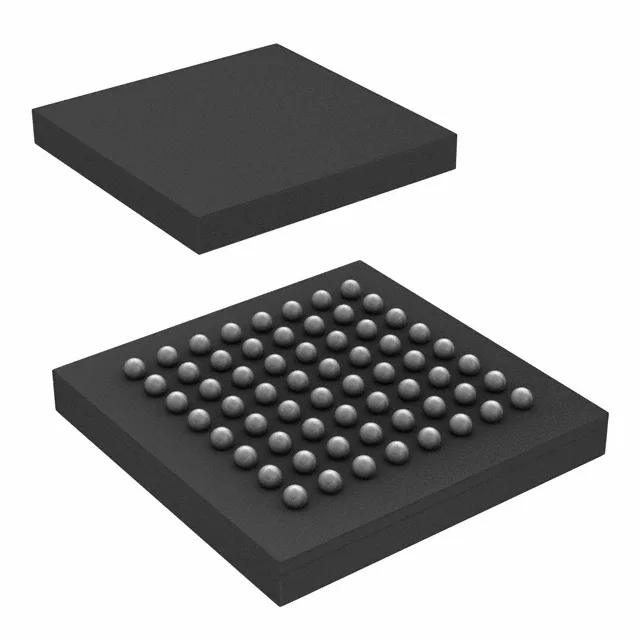
The 64-WLCSP (3.36 x 3.66 mm) is the smallest package option in the STM32L4 family. It saves board area but requires a controlled assembly process: the 0.4 mm ball pitch needs a good solder-paste stencil and a reflow profile tuned for the package. On-site field replacement is not practical — this is a pick-and-place part. If your production line is not set up for WLCSP, the STM32L462RET6 in a 64-LQFP is the same die in a more serviceable package.
The base product number is STM32L462, so any PCN or EOL communication will reference that base.