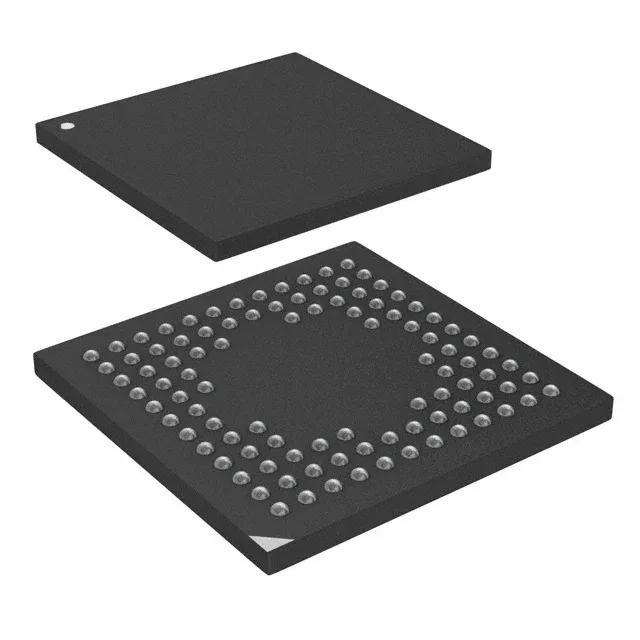
The STM32L452VEI6TR: The ARM Cortex-M4 core runs at 80 MHz. The 512 KB Flash and 160 KB SRAM support a real-time OS, USB stack, and sensor-fusion algorithms running concurrently.
The 100-UFBGA (7x7 mm) package is a fine-pitch BGA. The 83 I/O lines are distributed across the BGA, so fanout via blind vias is the standard approach; a four-layer board with a ground plane under the BGA keeps the return paths clean.
Industrial temperature — environment limits
It is not AEC-Q100 qualified, so it does not belong in under-hood automotive modules or transmission controllers. For cabin or chassis applications that stay within the temperature range, the part can still be used if the program accepts non-automotive-grade risk — but the procurement team should flag that it lacks the PPAP documentation an automotive OEM requires.
Peripheral set — what connects where
The connectivity block includes CANbus, USB, QSPI, and up to five UART/USART channels, so this MCU can serve as a protocol bridge between a CAN sensor network and a USB-attached host. The 16-channel 12-bit ADC and single 12-bit DAC cover analog front-end capture and control-loop output. Brown-out detect and the watchdog are standard STM32 safety features — the BOR keeps the core reset until the supply crosses 1.71 V, which is useful for single-cell Li-ion designs where the voltage sags under load.
For new designs, this means no immediate risk of a forced redesign.