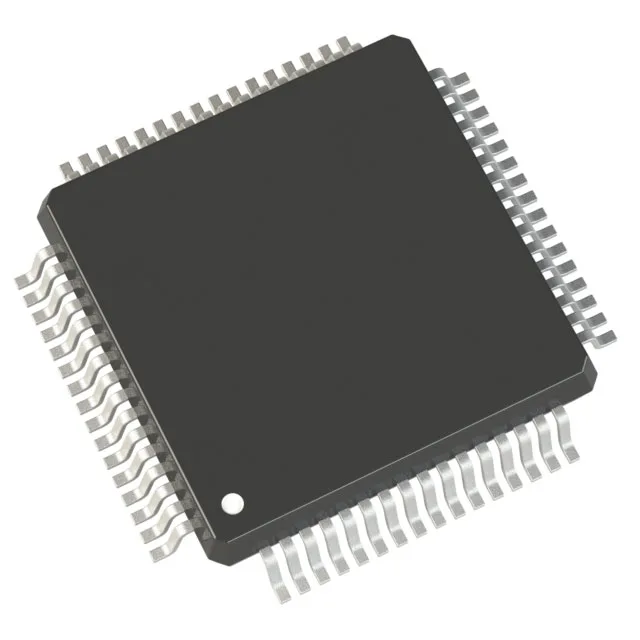
STMicroelectronics STM32L433RCT6 — Microcontrollers & Processors (MCU / MPU / DSP)

STM32L433RCT6 STM32L4 MCU, 80MHz Cortex-M4, 256KB Flash

MPNSTM32L433RCT6
Active

STMicroelectronics STM32L433RCT6, STM32L4 series, 32-bit ARM Cortex-M4 MCU, 80MHz, 256KB Flash, 64K x 8 SRAM, 64-LQFP (10x10), -40°C to 85°C, 1.71V to 3.6V supply.

$6.5200Ref. price · indicative, final on quote
Packaging64-LQFP
RoHSROHS3 Compliant
SeriesSTM32L4
Independent supplier — new & surplus stockAuthenticity-screened · ESD-safe packingListing updated Aug 2026

Specifications

STM32L433RCT6 specifications
ParameterValue
SeriesSTM32L4
MountingSurface Mount
Oscillator typeInternal
Program memory typeFLASH
Voltage - supply (Vcc (Vdd))1.71V ~ 3.6V
Operating temperature-40°C ~ 85°C (TA)
Speed80MHz
PackageTray
RAM size64K x 8
Core size32-Bit Single-Core
PeripheralsBrown-out Detect/Reset, DMA, LCD, PWM, WDT
ConnectivityCANbus, I²C, IrDA, LINbus, MMC/SD, QSPI, SAI, SPI, SWPMI, UART/USART, USB
Number of i (O)52
Core processorARM® Cortex®-M4
Case64-LQFP
Data convertersA/D 16x12b; D/A 2x12b
Program memory size256KB (256K x 8)

Product details

64-LQFP — rework-friendly footprint

The STM32L433RCT6: Housed in a 64-LQFP (10x10 mm) with 0.5 mm pitch, this package is a rework tech's friend. The gull-wing leads are visible under magnification, so you can inspect every joint after reflow. No hot-air risk to adjacent passives — a standard fine-tip iron or hot-air pencil lifts the part cleanly if the board needs a swap.

ROHS3 compliant, so it passes European and global material restrictions without an exemption.

The MCU integrates a CANbus controller for industrial fieldbus, a USB full-speed device/host, Quad-SPI for high-speed serial Flash or RAM expansion, and an SAI audio interface.

How it compares to the STM32L151CBU6A

The STM32L151CBU6A is an earlier Cortex-M3 part from the STM32L1 series, running at 32 MHz with a similar peripheral set (I²C, SPI, UART, USB) and the same 12-bit ADC/DAC resolution. The L433RCT6 more than doubles the core clock to 80 MHz and adds a floating-point unit, which matters for DSP or sensor-fusion algorithms. The L151 has fewer I/O (37 vs 52) and lacks the QSPI and SAI interfaces. If your code fits within the 32 MHz budget and you don't need the FPU, the L151 is a cost-optimized alternative; for higher throughput or audio/display work, the L433 is the right pick.

Frequently asked questions

What is the equivalent or alternative for STM32L433RCT6?

A functional alternative from the STM32L1 series is the STM32L151CBU6A, which runs at 32 MHz with a Cortex-M3 core, fewer I/O (37), and no FPU or QSPI. It is not a pin-compatible drop-in but serves a similar low-power role with a smaller memory footprint.