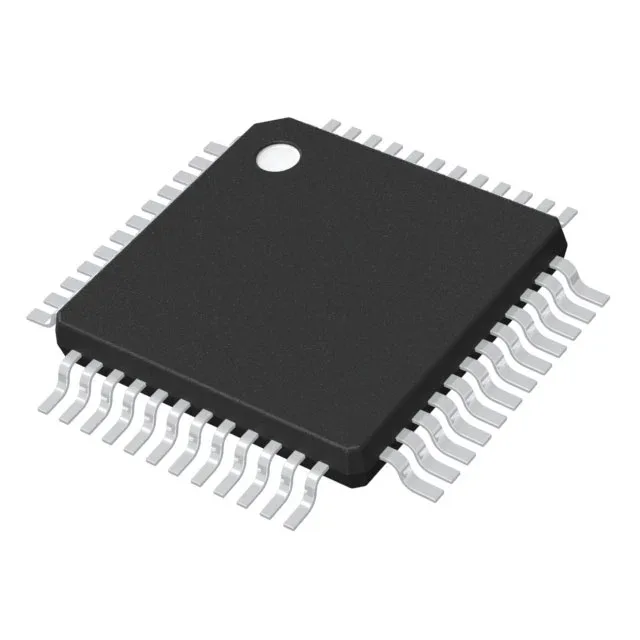
80 MHz Cortex-M4 — the performance tier that matters
The core includes a single-precision floating-point unit, so control loops with PID or sensor fusion math run in hardware rather than emulated in software. This is the mid-density entry in the STM32L4 series, aimed at applications that need the M4's DSP and FPU throughput but don't require the 512 KB or 1 MB Flash tiers that drive up BOM cost.
The part provides 38 GPIOs in the 48-LQFP package, along with a 10-channel 12-bit ADC and a 2-channel 12-bit DAC for analog signal chains. The QSPI interface is worth noting — it allows a direct-mapped external Flash or PSRAM for code execution or data logging without bit-banging. Peripheral integration also covers brown-out detect and reset, DMA, an LCD segment driver, PWM, and a watchdog timer.
Supply range and power profile
The STM32L4 family is ST's ultra-low-power line, so this part includes multiple low-power modes (sleep, stop, standby) that draw microamps in the deepest sleep states.
Housed in a 48-LQFP with a 7x7 mm body, the part is surface-mount and hand-solderable for prototype runs. The 48-pin LQFP is a common footprint shared across the STM32L4 density options, so a board laid out for the 128 KB variant can accept the 256 KB or 512 KB siblings without a PCB change.
It is ROHS3 compliant.