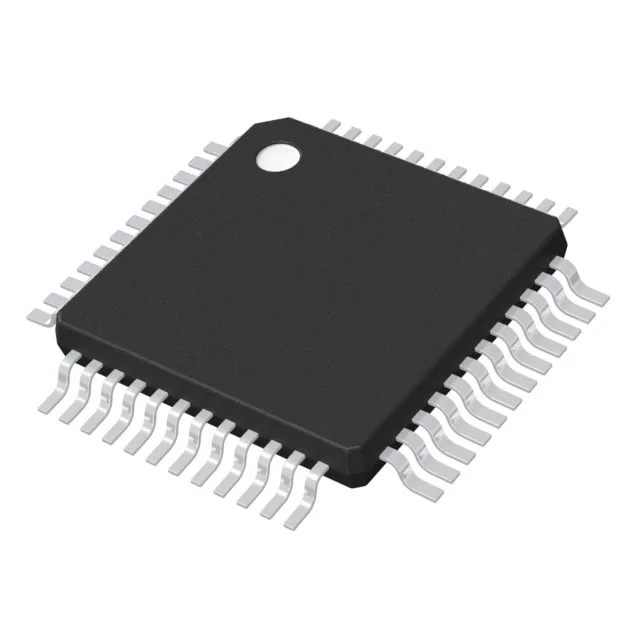
STMicroelectronics STM32L152CCT6 — Microcontrollers & Processors (MCU / MPU / DSP)

STM32L152CCT6 STM32L1 ARM Cortex-M3 MCU, 32 MHz, 48-LQFP

MPNSTM32L152CCT6
End of Life

STMicroelectronics STM32L1 series ARM Cortex-M3 MCU, STM32L152CCT6, 32 MHz, 256 KB Flash, 32 KB RAM, 8 KB EEPROM, 48-LQFP.

$7.37Ref. price · indicative, final on quote
Packaging48-LQFP
StockIn Stock (27)
Lead timeIn Stock wk
MOQ1 pcs
  • 100% new & originalTraceable channels only — no refurbs, no pulls, no remarked parts.
  • Date & lot codes on quoteStated per line before you commit; label photos on request.
  • MSL-compliant ESD packingMoisture-sealed bags with indicator cards; reels photo-verified.
  • PayPal buyer protectionPay by T/T, PayPal or Payoneer — card payments covered end to end.

Specifications

STM32L152CCT6 Technical Specifications
ParameterValue
SeriesSTM32L1
Mounting typeSurface Mount
Oscillator typeInternal
Program memory typeFLASH
Voltage - supply (Vcc (Vdd))1.8V ~ 3.6V
Operating temperature-40°C ~ 85°C (TA)
Speed32MHz
PackageTray
RAM size32K x 8
Core size32-Bit Single-Core
EEPROM size8K x 8
PeripheralsBrown-out Detect/Reset, Cap Sense, DMA, I2S, LCD, POR, PWM, WDT
ConnectivityI2C, IrDA, LINbus, SPI, UART/USART, USB
Number of i (O)37
Core processorARM® Cortex®-M3
Case48-LQFP
Data convertersA/D 14x12b; D/A 2x12b
Program memory size256KB (256K x 8)

Product details

Core and memory budget for mixed-signal control

The STM32L152CCT6: That Flash footprint is enough for a moderate RTOS plus a USB stack and a custom application layer; the 8 KB of true EEPROM (separate from the Flash array) stores calibration constants or configuration parameters without wearing the main program memory. The 32-bit single-core Cortex-M3 delivers a deterministic interrupt response and a hardware divide unit — the sort of core that handles a sensor-fusion loop or a motor-control FOC cycle without jitter from a software scheduler.

Peripheral set and analog integration

The Cap Sense peripheral handles capacitive touch buttons or sliders directly — no dedicated touch controller needed. Connectivity includes I²C, SPI, USART, and USB — enough for a fieldbus gateway or a data-logger that talks to a host PC over USB. The IrDA and LINbus support targets automotive or industrial serial links where a standard UART won't reach. The LCD peripheral drives a segment LCD panel directly, which saves a display driver IC in metering or HMI applications.

Supply voltage and temperature envelope

STMicroelectronics lists this part as Active in production and ROHS3 compliant.

A four-layer board is not strictly required, but a solid ground pour under the package helps with both thermal and EMI performance. With 37 I/O lines available, the LQFP-48 package gives enough pins for a sensor array, a small keypad, and a parallel LCD interface without multiplexing. The remaining pins are dedicated to power, ground, and the oscillator.

Frequently asked questions

What is the difference between STM32L152CCT6 and STM32L151CBU6A?

Both are STM32L1-series Cortex-M3 MCUs at 32 MHz with the same peripheral set. The key difference is the ADC channel count: the STM32L152CCT6 has 14x12-bit ADC channels, while the STM32L151CBU6A has 16x12-bit channels. The package also differs — the STM32L152CCT6 comes in a 48-LQFP, whereas the STM32L151CBU6A is in a UFQFPN-48 package. The pinout is not identical, so a board layout change is required to swap between them.

What compliance documentation does STMicroelectronics provide for STM32L152CCT6?

The part is ROHS3 compliant. Standard STMicroelectronics documentation includes the datasheet, reference manual, and application notes.