Memory mix: Flash, SRAM, and dedicated EEPROM
Unlike many Cortex-M0+ parts that emulate EEPROM in Flash, the STM32L073VBT6TR includes a true 6 KB EEPROM array with its own endurance and erase granularity. This matters for designs that log calibration constants, configuration profiles, or meter data without wearing the main Flash. The 128 KB Flash is sized for moderate firmware stacks — think sensor fusion, metrology, or a small RTOS — while the 20 KB SRAM handles a couple of moderate-size buffers and a modest stack. If your application needs more than 20 KB of RAM, check the STM32L073's sibling with 30 KB SRAM in the same 100-pin package.
At the top end, 3.6 V covers 3.3 V supplies with margin. The STM32L0 family is designed for sub-100 µA/MHz active draw and microamp sleep currents, so the headline 32 MHz clock is available when needed but the part can idle most peripherals between events. For a battery-powered sensor node that wakes briefly to read an ADC, process a sample, and push data over SPI, this part keeps the average current low enough to hit multi-year coin-cell targets.
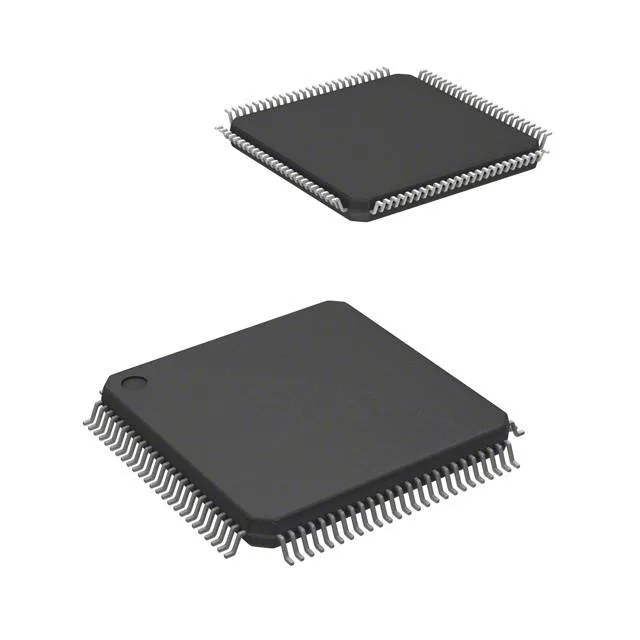
The 100-LQFP (14x14 mm) package with 84 I/O gives plenty of headroom for parallel buses, a parallel LCD interface, and multiple serial peripherals without multiplexing. MSL level is not stated in this listing, but LQFP packages from ST are typically MSL 3; verify the moisture sensitivity label on the reel for bake requirements if the seal is broken.
If you are dual-sourcing, the STM32L073 series includes pin-compatible density variants — same 100-LQFP footprint — that differ in Flash and RAM size, which can be qualified as a drop-in for supply flexibility.