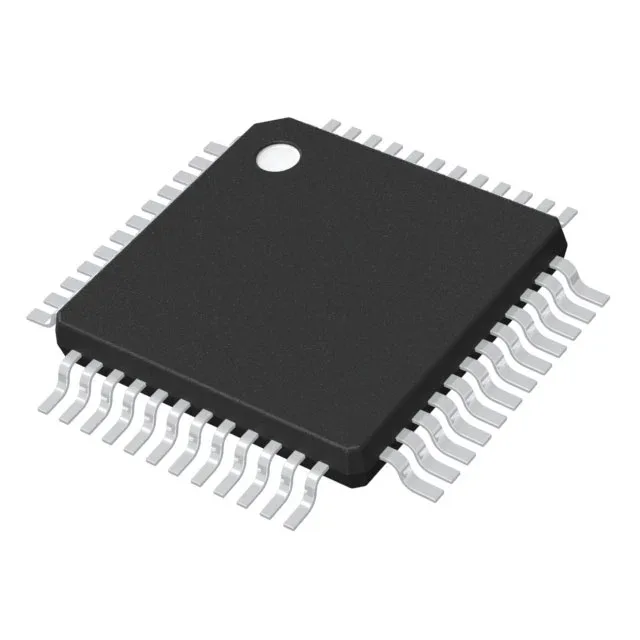
It runs at 32 MHz and carries 192 KB of Flash program memory, 20 KB of SRAM, and 6 KB of embedded EEPROM — enough on-chip storage to hold a moderate firmware image plus calibration or configuration data without an external serial EEPROM. The 48-LQFP package (7x7 mm) exposes 37 GPIOs, along with I²C, SPI, USART, and USB connectivity.
32 MHz is the maximum core clock for this STM32L0 device. That is sufficient for sensor polling, communication protocol handling (I²C, SPI, UART), and simple control loops.
On-chip memory: Flash, RAM, and EEPROM
The 20 KB SRAM handles typical data buffers and stack; if the design needs larger frame buffers or a TCP/IP stack, consider an external SRAM or a part with more RAM. The 6 KB EEPROM is a differentiator: it stores calibration constants, device IDs, or fault logs without an external I²C EEPROM, saving board space and a chip. EEPROM endurance is typically 100k write cycles, adequate for periodic parameter updates.