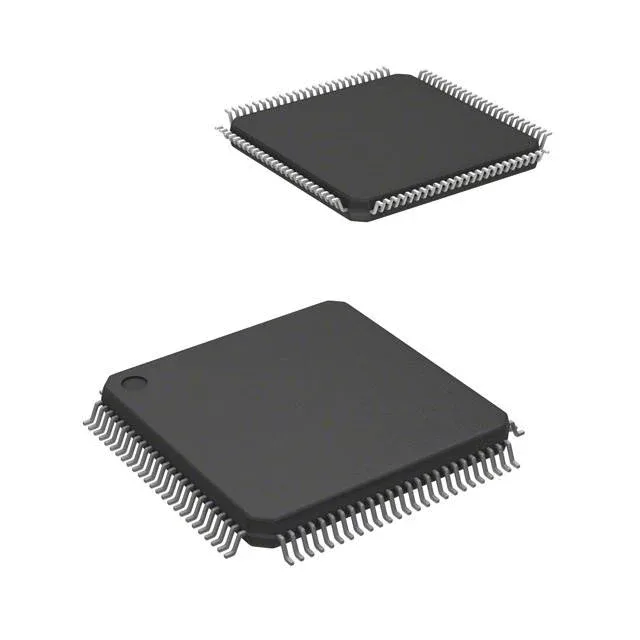
Ultra-low-power Cortex-M0+ with integrated EEPROM and analog
Supply and power budget
At 3.0 V the part can sustain a 32 MHz CPU clock; dropping below about 2.0 V the maximum clock rate reduces, but the MCU remains operational down to 1.65 V. This means a design running from two AA cells or a Li-SOCl2 battery can stay alive through the entire discharge curve without a boost converter. Brown-out detect and POR are integrated peripherals, so no external supervisor is needed for clean power-on reset or brown-out recovery. The watchdog timer (WDT) can be enabled in hardware to catch firmware hangs in unattended equipment.
Memory architecture and firmware strategy
The 64 KB Flash is sized for mid-complexity firmware — sensor fusion algorithms, USB protocol stacks, or Modbus RTU slaves fit comfortably. The 20 KB SRAM supports moderate data buffering, and the separate 3 KB EEPROM (emulated or true EEPROM cells depending on the STM32L0 variant) allows wear-leveled storage of calibration data, serial numbers, or logging counters without consuming Flash erase cycles. DMA offloads peripheral-to-memory transfers for ADC conversions, SPI data streaming, or UART reception, keeping the Cortex-M0+ free for control loops rather than byte-shuffling.
Connectivity and debug
IrDA support covers optical isolation links in industrial environments. The 100-LQFP package with 0.5 mm pitch routes reasonably on a two-layer board, though the 84 I/O count means careful signal assignment to avoid congested routing channels. The 14x14 mm body fits compact enclosures.
The base product number STM32L072 covers a range of Flash and RAM density options in the same 100-pin footprint, providing a pin-compatible upgrade path within the family without a PCB spin.