32 MHz Cortex-M0+ — enough throughput for sensor fusion and control loops
The 32 MHz core speed is the practical ceiling for this part. It handles sensor polling, PID loops, and communication protocol stacks without breaking a sweat, but it is not meant for heavy DSP or video. The Cortex-M0+ is a single-cycle I/O and interrupt-friendly core, so the 32 MHz clock translates to responsive GPIO toggling and low-latency ADC reads. For a battery-powered datalogger or a wireless sensor node, this speed tier keeps the active duty cycle short and the sleep current dominant.
128 KB Flash and 6 KB EEPROM — firmware and calibration storage
The separate 6 KB EEPROM is a real advantage: calibration constants, device serial numbers, and configuration parameters live in true EEPROM cells rated for 100k erase/write cycles, independent of the Flash sector-erase granularity. That means no wear-leveling code needed for frequently updated data.
The 1.65 V minimum supply is the key spec for single-cell alkaline or Li-ion designs. A CR2032 coin cell discharges to about 2.0 V; the STM32L071CBT6 keeps running down to 1.65 V, extracting nearly all the cell's energy. At the high end, 3.6 V covers a Li-ion cell fully charged (4.2 V is outside the range, so a small LDO is still needed for Li-ion — but the wide window simplifies rail design for primary cells).
Active lifecycle — no EOL worry for new designs
The base product number is STM32L071, and the series is STM32L0 — a mature, well-supported family with no imminent EOL signals.
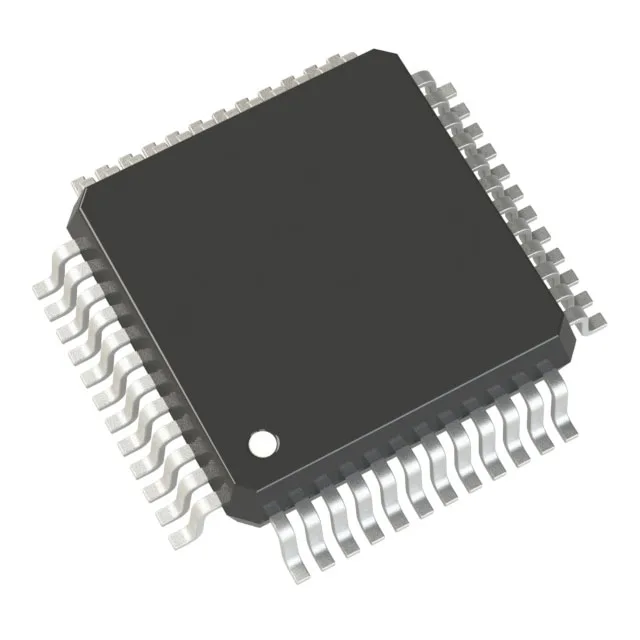
48-LQFP package — hand-solderable, 37 I/O
The 48-LQFP package with a 7x7 mm body is a standard gull-wing leaded package. It is easy to hand-solder for prototypes and rework-friendly in production. The 37 I/O lines are enough for a keypad, a small TFT display, or a handful of sensors and actuators.