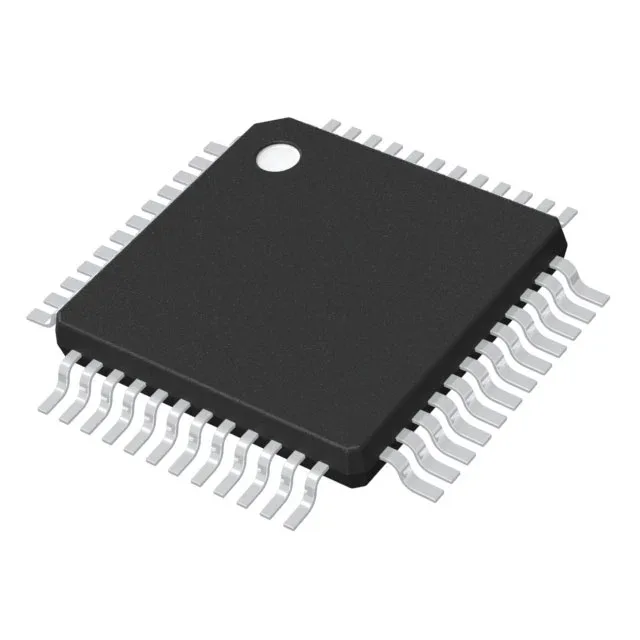
The part is rated for industrial temperature spans from -40 to 125 °C and operates from a supply voltage as low as 1.65 V up to 3.6 V, making it a natural fit for battery-powered or energy-harvesting equipment where every microamp counts. It comes in a 48-pin LQFP package (7x7 mm) with 37 GPIOs, a 13-channel 12-bit ADC, and connectivity including I²C, SPI, and USART.
The 32 MHz clock is the maximum for this Cortex-M0+ implementation in the STM32L0 family. For a repair-bench swap or a new BOM line, that speed determines whether the MCU can keep up with the peripheral bus timing.
On-chip EEPROM — no external part needed
The 6 KB of embedded EEPROM is a genuine BOM-simplifier. It eliminates the separate serial EEPROM IC and its associated PCB trace routing, which is one less component to fail or go end-of-life. For field-service techs, it means calibration data survives a firmware reload without an extra programming step. The EEPROM is rated for a high endurance cycle count, though the exact figure isn't listed here — treat it as suitable for frequent parameter updates.