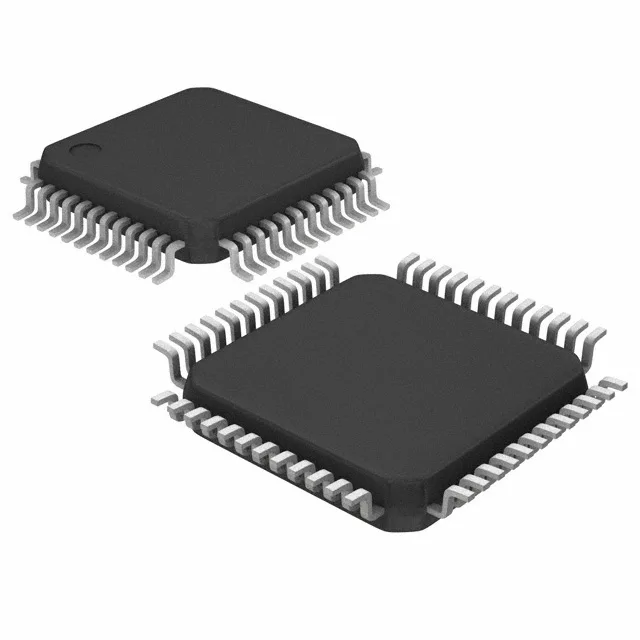
The 48-LQFP (7x7 mm) package with 37 I/O is a practical footprint for two-layer boards and hand-assembly rework.
32 MHz Cortex-M0+ — enough for sensor fusion, not for DSP
The 32 MHz ARM Cortex-M0+ core is a single-cycle, 32-bit engine with a two-stage pipeline. It handles sensor polling, protocol parsing, and control loops comfortably, but it lacks a hardware multiplier-accumulator for heavy DSP. The internal oscillator is available, so you can bring up the core without an external crystal for low-accuracy timing. For USB or a precision RTC, you will still need an external resonator.
Memory sizing: 64 KB Flash, 8 KB SRAM, 2 KB EEPROM
64 KB of Flash is the middle-density option in the STM32L0 family — enough for a Bluetooth stack, a sensor library, and application code, but tight if you are adding a full GUI or over-the-air update staging buffer. The 8 KB SRAM is the real constraint: it forces careful allocation of data buffers and a lean RTOS. The 2 KB EEPROM (2K x 8) is a genuine hardware EEPROM, not emulated Flash, so you can store calibration constants and configuration parameters without worrying about wear-leveling or sector-erase delays.
The base product number is STM32L063, so future die shrinks or package variants will carry the same base number, easing cross-reference management.