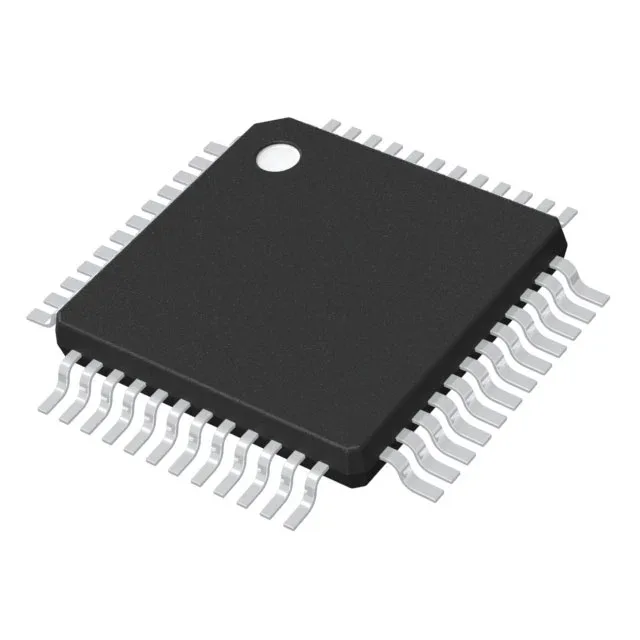
The STM32L053C8T6D: This part is active and qualified for new designs.
32 MHz Cortex-M0+ — what it buys you
The core runs at 32 MHz, which is the sweet spot for this ultra-low-power family: fast enough to handle sensor polling, LCD updates, and USB communication without waking a higher-clocked part, but clocked low enough that the dynamic current stays under control. If you are migrating from an 8-bit MCU, the 32-bit bus and single-cycle multiply will feel like a generation jump on FFT or PID loops.
Memory map for a battery-powered BOM
The EEPROM is useful for storing calibration constants and configuration data without wearing the Flash — each byte can be individually erased and rewritten up to 100k cycles, which is the kind of endurance a datalogger or metering application needs. The 8 KB SRAM is tight for a full TCP/IP stack, but it handles a lightweight BLE stack or a Modbus RTU buffer without external RAM.
Supply range and analog I/O
The 10-channel 12-bit ADC and single 12-bit DAC cover most sensor-conditioning and control-loop needs on a small board — no external converter required.
The LCD driver can directly drive a segmented glass display, saving a separate LCD controller chip.