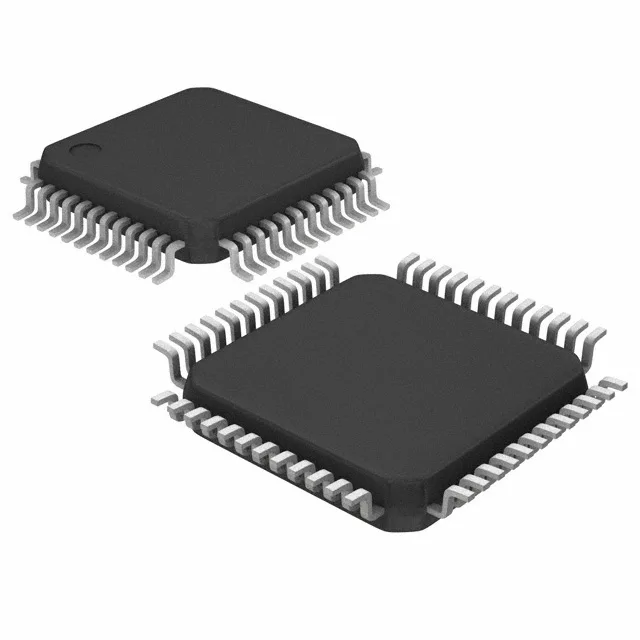
STM32L053C8T6 — what this ultra-low-power MCU brings
Peripherals include a 10-channel 12-bit ADC, a single 12-bit DAC, an LCD driver, I2S, DMA, and multiple serial interfaces (I2C, SPI, UART/USART, USB, IrDA). The 48-LQFP package provides 37 I/O lines in a 7x7 mm footprint for space-constrained boards.
Lifecycle status — still in active production
The ROHS3 compliance is current for global shipping.
32 MHz Cortex-M0+ — what the speed rating means for your application
The 32 MHz core clock is the ceiling for this ultra-low-power family. At that speed the Cortex-M0+ delivers enough throughput for sensor fusion, simple control loops, and communication protocol handling (USB, I2C, SPI) without needing a higher-power Cortex-M3 or M4.
Memory map — Flash, RAM, and EEPROM sizing
The 2 KB of embedded EEPROM survives 100k write cycles and does not require a separate external memory chip or wear-leveling in software.
No extended-temperature variant is listed for this code.
Package and I/O — 48-LQFP with 37 GPIOs
The 37 I/O lines include up to 26 alternate-function pins shared among the ADC, DAC, LCD segment driver, and serial interfaces. If your design needs more than 37 GPIOs or a smaller footprint, the same MCU is available in a 32-pin UFQFPN (STM32L053C6T6) or a 64-pin LQFP (STM32L053R8T6). The tray shipping medium is standard for prototype and low-volume orders; tape-and-reel options exist through ST's distribution.
How it compares to the STM32L151CBU6A
The STM32L151CBU6A is a Cortex-M3 sibling in the STM32L1 series, also running at 32 MHz with 37 I/O in a 48-pin package. The key difference is the core architecture: Cortex-M3 offers a single-cycle multiply and a hardware divider, while the Cortex-M0+ in the L053 is a von-Neumann design with a two-stage pipeline. For integer math-heavy firmware, the L151 gives about 30% more DMIPS at the same clock. The L053 counters with a lower stop-mode current (0.4 µA vs 1.2 µA typical) and a wider supply range down to 1.65 V (the L151 starts at 1.8 V). If your design is battery-life critical, stay with the L053; if you need more compute per cycle, the L151 is the alternative.