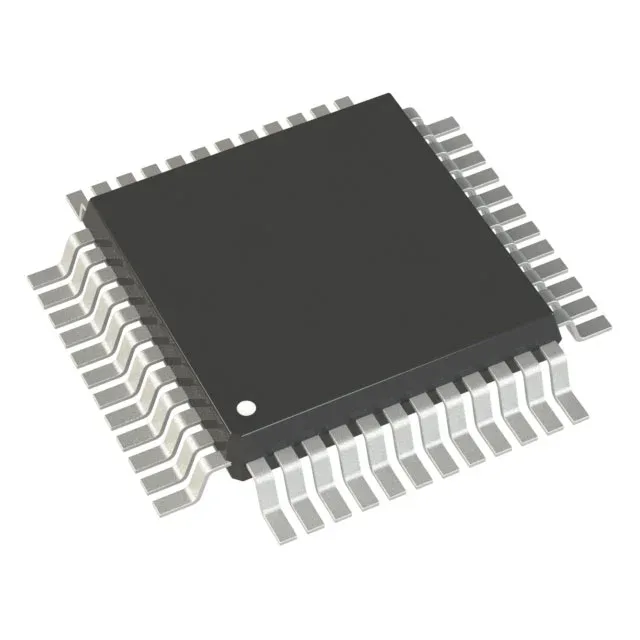
Active production — no obsolescence watch needed
The STM32L031K6T7: ROHS3 compliant per — no restricted substances to flag for EU or global BOM compliance.
32 MHz Cortex-M0+ — memory and peripheral budget
ARM Cortex-M0+ core running at 32 MHz — the speed ceiling is set by the flash wait-state profile, not the core alone. For a sensor node polling an ADC at 10 kHz and updating a PWM output, the 32 MHz clock leaves headroom for the application stack without entering wait states. 32 KB flash program memory with 8 KB SRAM and a separate 1 KB EEPROM block. The 8 KB RAM is tight for a full RTOS; a bare-metal or event-driven scheduler fits comfortably. 25 general-purpose I/O in the 32-LQFP package — enough to drive a small keypad, a few LEDs, and communicate over I²C or SPI with external sensors. The 10-channel 12-bit ADC covers analog inputs like thermistors or potentiometers without an external mux.
Supply and temperature — industrial deployment envelope
The low end at 1.8 V suits battery-powered designs where the cell is nearly depleted. An outdoor IoT gateway in a sealed enclosure that sees 85 °C on a summer roof still has 20 °C of margin before the silicon derates. Internal oscillator eliminates the need for an external crystal in many applications, saving two pins and board space. The internal RC is trimmed to ±1 % accuracy over temperature — adequate for UART baud-rate generation but not for precision timing.
Package and board-fit — 32-LQFP 7x7 mm
Supplied in tray format — not tape-and-reel. For low-volume prototyping or manual assembly, tray packaging avoids the cost of reel fees. For automated pick-and-place, confirm the feeder compatibility with your line.
Connectivity and peripherals — sensor and actuator interface
I²C, SPI, and UART/USART are present — covers the common sensor buses (I²C for temperature/humidity sensors, SPI for external ADCs or displays, UART for debug or wireless modules). IrDA and LINbus add automotive or infrared communication capability. The DMA offloads the CPU during ADC conversions or memory transfers — useful when the core is in sleep mode and a peripheral needs to move data without waking the processor.