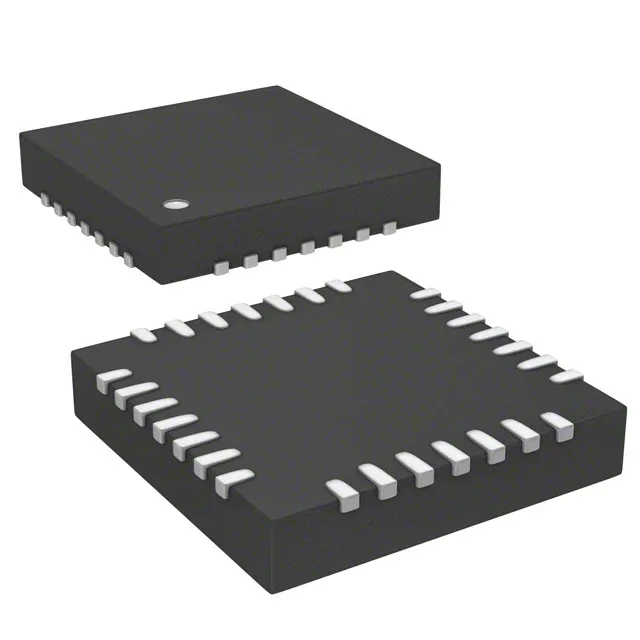
The STM32L031G6U6TR: The 28-pin UFQFPN package measures 4x4 mm, making it a fit for space-constrained, battery-operated designs like sensor nodes, portable medical devices, and industrial IoT endpoints where every milliwatt and square millimeter counts.
The 32 KB Flash is the firmware budget; the 8 KB RAM handles stack, heap, and data buffers. The 1 KB EEPROM saves calibration constants or configuration data without wearing the Flash — useful for field-updatable parameters. The 21 GPIOs and 10-channel 12-bit ADC give enough I/O for a handful of sensors and a serial display or keypad. Built-in brown-out detect, power-on reset, and a watchdog timer reduce external supervisory ICs. The DMA engine can move ADC results to RAM without CPU intervention, saving power in data-logging applications.
For a production BOM, this means no immediate LTB risk and continued manufacturer support.
32 MHz Cortex-M0+ — what the core speed means for your design
The 32 MHz ceiling is the Cortex-M0+ sweet spot for ultra-low-power operation. At this clock the core draws roughly a third of the current of a Cortex-M3 running at the same speed, which directly extends battery life in duty-cycled applications. The trade-off is that the M0+ lacks a hardware multiplier (it does integer multiply in software) and has no MPU — fine for simple control loops and sensor fusion, but not for heavy DSP or multi-threaded RTOS with memory protection.