Active production — no end-of-life risk for this STM32L0 entry
The STM32L011F3U6TR: ROHS3 compliant per the manufacturer's declaration, with no REACH or conflict-mineral restrictions flagged in the standard compliance package.
32 MHz Cortex-M0+ with 8 KB flash — what the memory budget really means
The ARM Cortex-M0+ core runs at 32 MHz — enough for sensor polling, communication protocol handling, and simple control loops. The 8 KB flash (8K x 8) and 2 KB RAM (2K x 8) limit firmware complexity; expect to fit a lightweight RTOS or a bare-metal scheduler, but not a full TCP/IP stack with buffers. 512 bytes of on-chip EEPROM (512 x 8) stores calibration coefficients, node IDs, and configuration parameters that survive power cycles without wearing the flash. The 7-channel 12-bit ADC (A/D 7x12b) covers multi-sensor analog front-ends — temperature, pressure, light, or battery voltage monitoring — all on one chip without an external mux.
The internal oscillator (Oscillator Type: Internal) eliminates the external crystal for the main clock in many applications, though an external source can still be fed through the UART/USART pins for precise baud-rate generation.
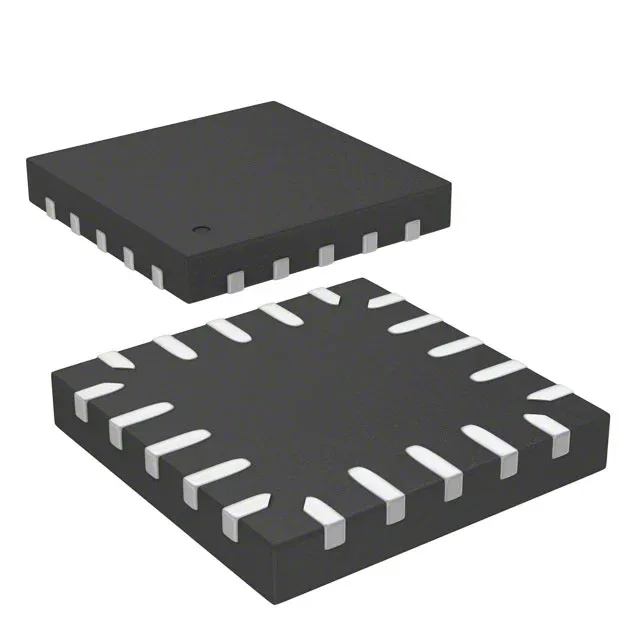
20-UFQFPN 3x3 mm — rework reality for a tiny QFN
Housed in a 20-UFQFPN package measuring 3x3 mm (Supplier Device Package: 20-UFQFPN (3x3)), this is a small QFN with an exposed pad underneath. Surface-mount only (Mounting Type: Surface Mount). The 0.5 mm pitch QFN is reworkable with hot air if the board has adequate solder mask dams between pads — but the exposed pad makes hand-soldering impractical. A pre-heated bottom side helps prevent tombstoning during reflow. 16 I/O pins (Number of I/O: 16) in a 20-pin package means four pins are dedicated to power and ground — plan the pin allocation early because the I/O count is tight for designs needing multiple serial interfaces simultaneously.
The 32 MHz core speed is guaranteed across this range, though flash access may require wait states at the high end. Peripherals include Brown-out Detect/Reset, POR, PWM, WDT, and DMA — the brown-out detector prevents corrupted flash writes during power loss, critical for battery-powered field devices that may be hot-swapped. Connectivity options: I²C, IrDA, SPI, and UART/USART — enough for a sensor hub talking to a radio module (SPI) and a debug console (UART) simultaneously, but no CAN or USB built in.