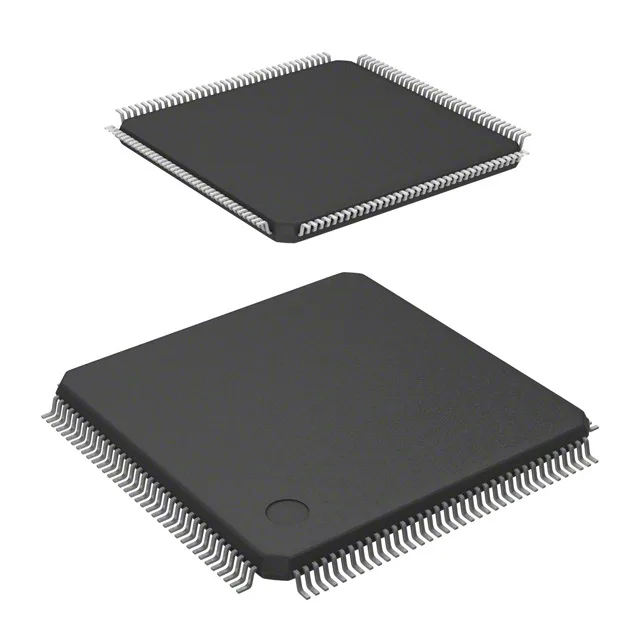
STMicroelectronics STM32H7A3ZIT6Q — Microcontrollers & Processors (MCU / MPU / DSP)

STM32H7A3ZIT6Q STM32H7 MCU, 280 MHz Cortex-M7, 2 MB Flash

MPNSTM32H7A3ZIT6Q
Active

STMicroelectronics STM32H7 series STM32H7A3ZIT6Q, ARM Cortex-M7 32-Bit Single-Core MCU, 280MHz, 2MB FLASH, 1.4M x 8 RAM, 112 I/O, 144-LQFP, -40°C~85°C.

$13.6154Ref. price · indicative, final on quote
StockContact for availability
MOQ1 pcs
  • 100% new & originalTraceable channels only — no refurbs, no pulls, no remarked parts.
  • Date & lot codes on quoteStated per line before you commit; label photos on request.
  • MSL-compliant ESD packingMoisture-sealed bags with indicator cards; reels photo-verified.
  • PayPal buyer protectionPay by T/T, PayPal or Payoneer — card payments covered end to end.

Specifications

STM32H7A3ZIT6Q Technical Specifications
ParameterValue
SeriesSTM32H7
Mounting typeSurface Mount
Oscillator typeInternal
Program memory typeFLASH
Voltage - supply (Vcc (Vdd))1.62V ~ 3.6V
Operating temperature-40°C~85°C(TA)
Speed280MHz
PackageTray
RAM size1.4M x 8
Core size32-Bit Single-Core
PeripheralsBrown-out Detect/Reset, DMA, I²S, LCD, POR, PWM, WDT
ConnectivityCANbus, EBI/EMI, HDMI-CEC, I²C, IrDA, LINbus, MDIO, MMC/SD/SDIO, SAI, SPDIF, SPI, SWPMI, UART/USART, USB OTG
Number of i (O)112
Core processorARM® Cortex®-M7
Case144-LQFP
Data convertersA/D 20x16b; D/A 3x12b
Program memory size2MB (2M x 8)

Product details

The 112 I/O lines, routed through a 144-LQFP package (20x20 mm footprint), provide ample GPIO for sensor arrays, display interfaces, and motor-control feedback.

1.4 MB RAM and 280 MHz — sizing the compute and data budget

The 280 MHz Cortex-M7 core handles DSP-style math and real-time control loops that would stall a 100 MHz MCU. With 1.4 MB of SRAM, this part can buffer multiple camera frames, hold a large audio sample pool, or run a TCP/IP stack with generous socket buffers — all on-chip. The 2 MB Flash supports a full-featured firmware image with a bootloader, application code, and a file system for configuration data. For designs that need more memory, the EBI/EMI interface (listed in the connectivity block) lets you attach external SDRAM or NOR Flash without a glue-logic CPLD.

Connectivity and peripherals — what the 112 I/O actually connects to

The peripheral set covers industrial and consumer interfaces: CANbus for automotive or machinery networks, USB OTG for device-to-host communication, multiple SPI and I²C buses for sensors and converters, SAI for I²S audio, and an LCD parallel interface for TFT displays. The 20-channel 16-bit ADC and three 12-bit DAC handle analog front-end tasks without an external converter. Brown-out detect and POR simplify power sequencing, while the DMA engine moves data without loading the core.

Package and supply — layout decisions for the 144-LQFP

The 144-LQFP (20x20 mm) is a standard QFP with 0.5 mm pitch — easier to route and rework than a BGA of equivalent I/O count. The supply range of 1.62 V to 3.6 V lets it run from a single 3.3 V rail or a 1.8 V low-power domain. Surface-mount assembly follows typical LQFP profiles; no special bake-out is required if the moisture-barrier bag is intact.

Frequently asked questions

What is the closest pin-compatible alternative to STM32H7A3ZIT6Q in this component family?

The STM32H7 series includes multiple density and feature variants in the 144-LQFP package. Within the STM32H7A3 line, devices share the same footprint and pinout, differing in Flash and RAM sizes.

What is STM32H7A3ZIT6Q's listed speed on this component line?

The STM32H7A3ZIT6Q is rated for a 280 MHz core speed on the ARM Cortex-M7 processor.