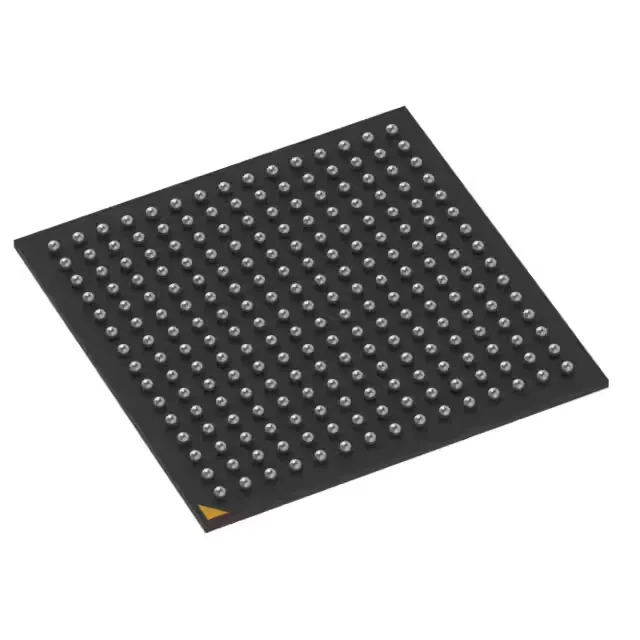
The 280 MHz core speed, combined with the Cortex-M7's single-cycle multiply-accumulate and double-precision FPU, makes this part a fit for real-time control loops in motor drives, audio processing pipelines, and graphical HMI systems that would otherwise need a separate DSP or FPGA. The 1.4 MB RAM is unusually large for a single-core MCU in this package class — enough to hold a full frame buffer for a 480x272 TFT display with a touch overlay, or to run a dual-bank OTA firmware update scheme without external SDRAM. The 168 general-purpose I/O lines, spread across a 225-ball TFBGA (13x13 mm), give enough pins to interface a parallel RGB LCD, a camera sensor, and multiple UART/SPI peripherals simultaneously. The supply range spans 1.62 V to 3.6 V, which lets the core run at 1.8 V for lower dynamic power while the I/O banks operate at 3.3 V to interface with legacy peripherals.
Connectivity and peripheral set — one chip for the fieldbus and HMI
This peripheral density lets a single MCU handle the fieldbus gateway, the local HMI display, and the sensor acquisition chain without external bridge chips. The EBI/EMI memory controller can map external SRAM, NOR Flash, or a parallel LCD controller directly into the 32-bit address space. Data converters include 24 analog inputs multiplexed into a 16-bit ADC and three 12-bit DAC outputs — enough for simultaneous current sensing on a three-phase motor drive plus a reference voltage output.
Package and assembly — 225-TFBGA (13x13)
The 225-ball TFBGA measures 13x13 mm with a 0.8 mm ball pitch. This is a four-layer-PCB-friendly pitch — escape routing on two signal layers is feasible without microvias. The 168 I/O lines are distributed across the ball grid, so the PCB layout needs careful fan-out planning if all peripherals are used simultaneously. Surface-mount only. The thermal pad at the center of the BGA carries the bulk of the junction-to-board heat path; a via stitch under the pad is recommended for continuous operation above 400 mA core current.
There is no NRND notice or last-time-buy schedule attached to this base number.