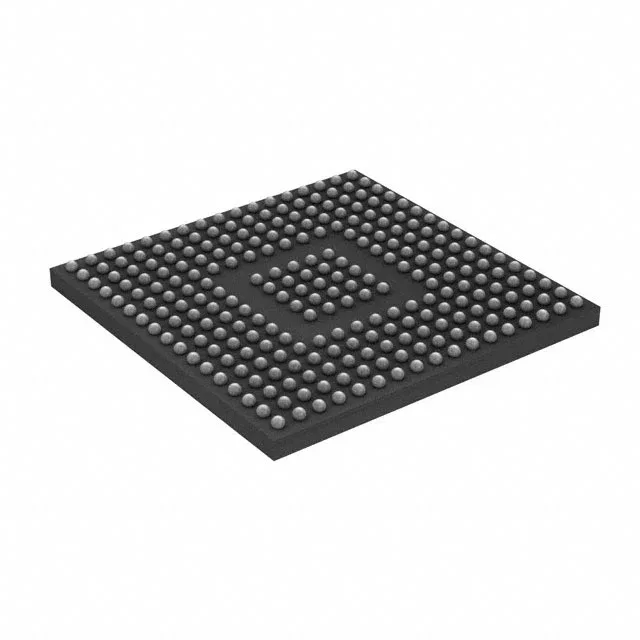
Dual-core architecture — what the speed split means for your firmware partition
The STM32H757XIH6U is a 32-bit dual-core MCU from STMicroelectronics' STM32H7 series, pairing an ARM Cortex-M4 at 240 MHz with a Cortex-M7 at 480 MHz. That speed split is deliberate: the M7 handles number-crunching and real-time control loops at full throttle, while the M4 runs communications stacks or housekeeping tasks without starving the M7's cache. Both cores share 2 MB of Flash and 1 MB of RAM, so firmware teams need to partition code and data carefully — the memory map is unified, but contention on the bus arbiter is real if both cores hammer the same peripheral simultaneously.
Peripheral set and connectivity — what is on the bus
168 I/O lines bring out a rich peripheral set: dual CANbus, Ethernet MAC, USB OTG, multiple SPI/I²C/UART, plus an EBI/EMI for external memory or FPGA glue. The 36-channel 16-bit ADC and dual 12-bit DAC cover multi-sensor acquisition and analog output without external converters — a board-space and BOM consolidation factor for mixed-signal designs.