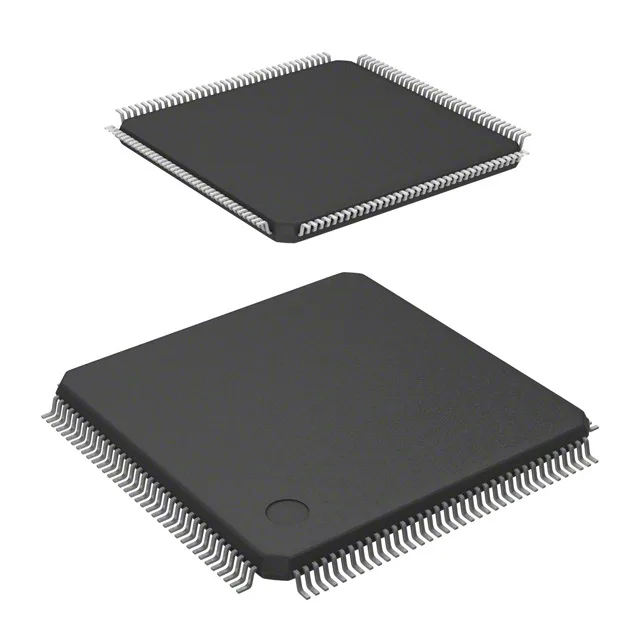
STMicroelectronics STM32H755ZIT6 — Microcontrollers & Processors (MCU / MPU / DSP)

STM32H755ZIT6 Dual-Core MCU, 240/480MHz, 2MB Flash, 144-LQFP

MPNSTM32H755ZIT6
Active

STMicroelectronics STM32H7 series, ARM Cortex-M4/M7 dual-core 32-bit MCU, 240MHz/480MHz, 2MB Flash, 1M x 8 RAM, 144-LQFP (20x20mm), -40°C~85°C, 1.62V~3.6V.

$21.6400Ref. price · indicative, final on quote
StockContact for availability
MOQ1 pcs
  • 100% new & originalTraceable channels only — no refurbs, no pulls, no remarked parts.
  • Date & lot codes on quoteStated per line before you commit; label photos on request.
  • MSL-compliant ESD packingMoisture-sealed bags with indicator cards; reels photo-verified.
  • PayPal buyer protectionPay by T/T, PayPal or Payoneer — card payments covered end to end.

Specifications

STM32H755ZIT6 Technical Specifications
ParameterValue
SeriesSTM32H7
Mounting typeSurface Mount
Oscillator typeInternal
Program memory typeFLASH
Voltage - supply (Vcc (Vdd))1.62V ~ 3.6V
Operating temperature-40°C~85°C(TA)
Speed240MHz, 480MHz
PackageTray
RAM size1M x 8
Core size32-Bit Dual-Core
PeripheralsBrown-out Detect/Reset, DMA, I²S, LCD, POR, PWM, WDT
ConnectivityCANbus, EBI/EMI, Ethernet, I²C, IrDA, LINbus, MDIO, MMC/SD/SDIO, QSPI, SAI, SPDIF, SPI, SWPMI, UART/USART, USB OTG
Number of i (O)97
Core processorARM® Cortex®-M4/M7
Case144-LQFP
Data convertersA/D 23x16b; D/A 2x12b
Program memory size2MB (2M x 8)

Product details

Dual-core architecture — what the 240 MHz and 480 MHz mean for task split

The STM32H755ZIT6 pairs a Cortex-M7 running at 480 MHz with a Cortex-M4 at 240 MHz on the same die. The M7 handles the heavy compute — real-time FFT, motor-control loops, or protocol stacks — while the M4 runs the housekeeping: sensor polling, display refresh, or low-power background tasks. Both cores share the 2 MB Flash and 1 MB SRAM through the bus matrix, so the memory budget needs to account for concurrent access patterns.

Memory and peripherals — sizing the BOM

With 2 MB of Flash and 1 MB of SRAM, this part sits in the high-density tier of the STM32H7 family — enough for a full TCP/IP stack, a graphics framebuffer, or dual-channel audio processing without external memory. The peripheral set includes dual CAN-FD, Ethernet MAC, USB OTG, eight UART/USART, six SPI, three I²C, and a parallel EBI/EMI bus for connecting external SRAM, NOR Flash, or an LCD controller. The 23-channel 16-bit ADC and two 12-bit DACs cover most analog front-end requirements.

Package and assembly — 144-LQFP in production

The 144-LQFP (20x20 mm) with 0.5 mm pitch is a standard surface-mount package that can be hand-soldered for prototyping and runs on any conventional SMT line.

Frequently asked questions

What is the listed speed (240 MHz, 480 MHz) on this component line?

The Cortex-M7 core runs at 480 MHz and the Cortex-M4 core runs at 240 MHz. This asymmetric clocking lets you partition workloads: the M7 handles the compute-intensive tasks while the M4 manages lower-rate housekeeping.

Can STM32H755ZIT6 be programmed with standard ST-Link/V2?

The STM32H755ZIT6 supports SWD and JTAG debug interfaces, which are compatible with standard ST-Link/V2 and V3 programmers. No special adapter is needed for firmware development or production programming.

What is the closest pin-compatible alternative to STM32H755ZIT6 in this component family?

The STM32H753ZIT6 is a single-core (Cortex-M7 only) pin-compatible alternative within the same 144-LQFP package. It lacks the second Cortex-M4 core but shares the same footprint, memory map, and peripheral set, making it a drop-in option for designs that do not require dual-core partitioning.