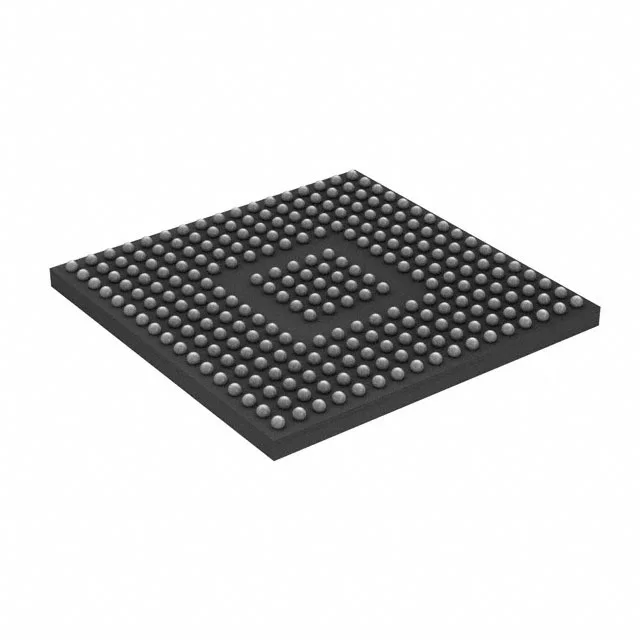
Dual-core asymmetric architecture — 240 MHz Cortex-M4 plus 480 MHz Cortex-M7
The STM32H755XIH6 is STMicroelectronics' flagship dual-core MCU from the STM32H7 series, pairing a 480 MHz ARM Cortex-M7 for heavy compute with a 240 MHz Cortex-M4 for real-time control or communications offload. This asymmetric architecture lets you partition tasks — the M7 runs the DSP or AI inference pipeline while the M4 handles deterministic control loops, protocol stacks, or sensor fusion without contention. Both cores share the 2 MB Flash and 1 MB SRAM through a multi-layer AXI interconnect, so data exchange is coherent without external FIFOs.
Memory budget for complex applications
With 2 MB of Flash (2M x 8) and 1 MB of SRAM (1M x 8), this part can host a full RTOS, a graphics or HMI stack, and dual protocol stacks without external memory. The RAM is enough for a 480p frame buffer or large audio processing pipelines. The Flash endurance is rated 100k write cycles per sector — wear-leveling in the filesystem layer keeps the config block alive for a decade of field updates.
Connectivity and peripheral set for system hub role
The peripheral list reads like a gateway MCU: dual CANbus, Ethernet, USB OTG, dual SAI (for I2S audio), QSPI, SD/SDIO, and a parallel EBI/EMI bus for external memory or FPGAs. The 168 I/O in a 265-TFBGA package gives you enough pins to connect multiple sensors, displays, and actuators without a port expander. The 36-channel 16-bit ADC bank and 2-channel 12-bit DAC cover analog front-end needs for motor current sensing, audio input, or battery monitoring.
The thermal pad carries most of the dissipation; without a via stitch under the pad the junction runs away above 400 mA continuous core current.