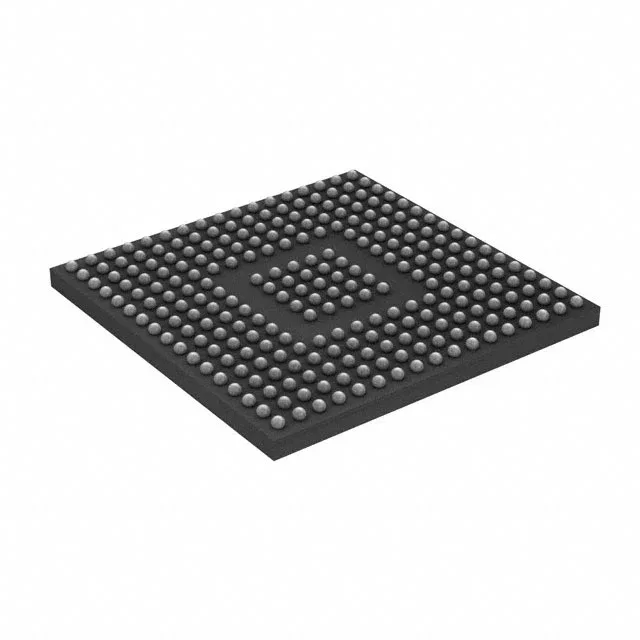
The STM32H750XBH6 is STMicroelectronics' high-performance MCU built around a single ARM Cortex-M7 core clocked at 480 MHz. It carries 128 KB of on-chip Flash and 1M x 8 of RAM, making it a compute-focused part where the heavy lifting happens in external memory or through the rich peripheral set. The 168 I/O lines and connectivity including Ethernet, USB OTG, CANbus, and QSPI suit it for industrial gateways, motor control HMI panels, and networked sensor hubs where the processor runs the protocol stack and the application logic lives off-chip.
Flash endurance and the external-memory strategy
128 KB of Flash is small for a 480 MHz core — this part is designed to boot from internal Flash and then execute from external QSPI NOR or SDRAM via the flexible memory controller (EBI/EMI). Budget the ECC if you store configuration data in internal Flash over the product's lifetime; the 128 KB sector is best reserved for bootloader and critical parameters, with application code mapped externally. The 1M x 8 RAM gives room for code shadowing and large frame buffers without external DRAM in many designs.
The 36-channel 16-bit ADC and dual 12-bit DAC handle analog front-end tasks without an external converter. Brown-out detect, POR, and a built-in watchdog reduce external supervisory components. The internal oscillator keeps the core running during boot, though an external crystal is recommended for Ethernet timing accuracy.
Housed in a 265-ball TFBGA (240+25) with a 14x14 mm body. The fine-pitch BGA requires controlled impedance on the high-speed interfaces and careful decoupling — plan for multiple 100 nF caps distributed around the ball field. Supply voltage spans 1.62 V to 3.6 V, allowing single 3.3 V or 1.8 V rail operation.
For dual-sourcing evaluation, note that the STM32L151CBU6A is a different performance tier (32 MHz Cortex-M3) and not a pin-compatible substitute; the STM32H750IBK6 shares the same base number but differs in package variant.