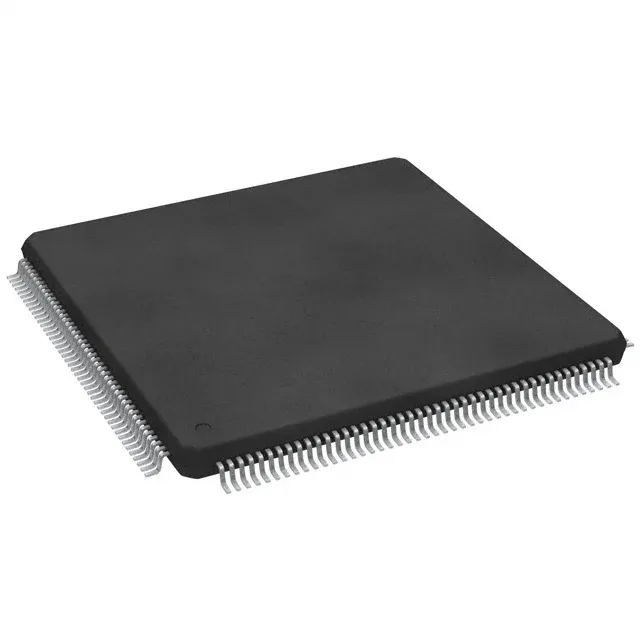
STMicroelectronics STM32H747IIT6 — Microcontrollers & Processors (MCU / MPU / DSP)

STM32H747IIT6 STM32H7 Dual-Core MCU, 240/480 MHz, 2 MB Flash

MPNSTM32H747IIT6
Active

ST STM32H7 series, STM32H747IIT6, 32-Bit Dual-Core ARM Cortex-M4/M7, 240MHz, 480MHz, 2MB Flash, 1M x 8 RAM, 168 I/O, 176-LQFP, -40°C to 85°C.

$19.4300Ref. price · indicative, final on quote
Packaging176-LQFP
RoHSROHS3 Compliant
SeriesSTM32H7
Independent supplier — new & surplus stockAuthenticity-screened · ESD-safe packingListing updated Aug 2026

Specifications

STM32H747IIT6 specifications
ParameterValue
SeriesSTM32H7
MountingSurface Mount
Oscillator typeInternal
Program memory typeFLASH
Voltage - supply (Vcc (Vdd))1.62V ~ 3.6V
Operating temperature-40°C ~ 85°C (TA)
Speed240MHz, 480MHz
PackageTray
RAM size1M x 8
Core size32-Bit Dual-Core
PeripheralsBrown-out Detect/Reset, DMA, I2S, LCD, POR, PWM, WDT
ConnectivityCANbus, EBI/EMI, Ethernet, I2C, IrDA, LINbus, MDIO, MMC/SD/SDIO, QSPI, SAI, SPDIF, SPI, SWPMI, UART/USART, USB OTG
Number of i (O)168
Core processorARM® Cortex®-M4/M7
Case176-LQFP
Data convertersA/D 28x16b; D/A 2x12b
Program memory size2MB (2M x 8)

Product details

Dual-core architecture that splits real-time and application processing

The STM32H747IIT6 is a 32-bit dual-core microcontroller from ST's STM32H7 series, combining an ARM Cortex-M7 core running at 480 MHz with a Cortex-M4 core at 240 MHz on a single die. The 2 MB Flash and 1 MB RAM give enough headroom for a combined real-time control loop and a rich user interface or communications stack. The 176-LQFP package keeps board layout manageable for industrial motor drives, high-end PLCs, and display-centric human-machine interfaces where the dual-core split offloads the GUI rendering from the control logic.

480 MHz Cortex-M7 plus 240 MHz Cortex-M4 — what that buys you

The Cortex-M7 handles the heavy compute — signal processing, floating-point math, or Ethernet stack — while the Cortex-M4 runs the deterministic control loop or sensor fusion without contention. Both cores share the 2 MB Flash and 1 MB RAM through the internal bus matrix, so there is no external memory needed for most designs. The 168 I/O and the full set of peripherals (CANbus, Ethernet, USB OTG, multiple SPI/I2C, QSPI, SAI, SPDIF) mean this single part can replace what used to require two MCUs and a bridge chip.

Lifecycle and channel posture

That means normal factory allocation and no last-time-buy pressure.

Frequently asked questions

What is the difference between STM32H747IIT6 and STM32H743IIT6?

The STM32H747IIT6 adds a second Cortex-M4 core at 240 MHz alongside the Cortex-M7 at 480 MHz, whereas the STM32H743IIT6 is a single-core Cortex-M7 part. Both share the same 176-LQFP footprint and peripheral set, but the H747 lets you run a real-time task on the M4 while the M7 handles application code or DSP.

Does the STM32H747IIT6 support dual-core simultaneous debug?

Yes, the dual-core architecture supports simultaneous debug via the SWD interface. Each core has its own debug access port, so you can halt, step, and inspect registers on the M7 and M4 independently in a single debug session.