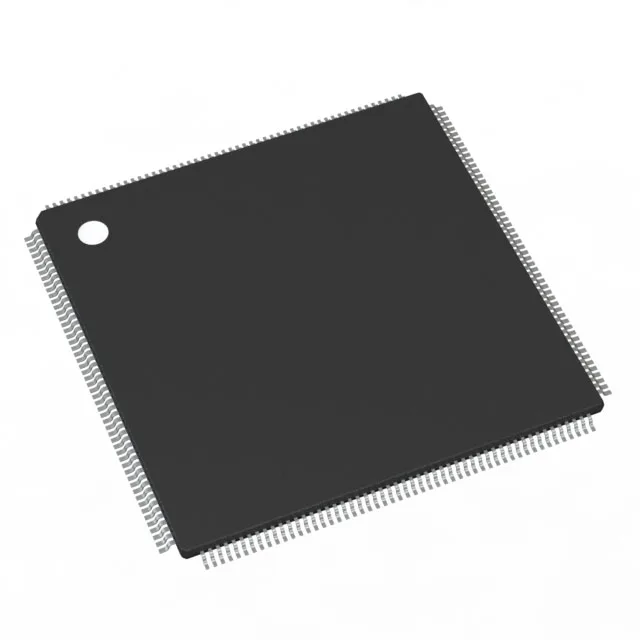
STMicroelectronics STM32H747BGT6 — Microcontrollers & Processors (MCU / MPU / DSP)

STM32H747BGT6 STM32H7 Dual-Core MCU, 240MHz/480MHz

MPNSTM32H747BGT6
Active

STMicroelectronics STM32H7 series, STM32H747BGT6, 32-Bit Dual-Core ARM Cortex-M4/M7, 240MHz, 480MHz, 1MB (1M x 8) FLASH, 1M x 8 RAM, 148 I/O, 208-LQFP, -40°C~85°C.

$16.0175Ref. price · indicative, final on quote
StockContact for availability
MOQ1 pcs
  • 100% new & originalTraceable channels only — no refurbs, no pulls, no remarked parts.
  • Date & lot codes on quoteStated per line before you commit; label photos on request.
  • MSL-compliant ESD packingMoisture-sealed bags with indicator cards; reels photo-verified.
  • PayPal buyer protectionPay by T/T, PayPal or Payoneer — card payments covered end to end.

Specifications

STM32H747BGT6 Technical Specifications
ParameterValue
SeriesSTM32H7
Mounting typeSurface Mount
Oscillator typeInternal
Program memory typeFLASH
Voltage - supply (Vcc (Vdd))1.62V ~ 3.6V
Operating temperature-40°C~85°C(TA)
Speed240MHz, 480MHz
PackageTray
RAM size1M x 8
Core size32-Bit Dual-Core
PeripheralsBrown-out Detect/Reset, DMA, I²S, LCD, POR, PWM, WDT
ConnectivityCANbus, EBI/EMI, Ethernet, I²C, IrDA, LINbus, MDIO, MMC/SD/SDIO, QSPI, SAI, SPDIF, SPI, SWPMI, UART/USART, USB OTG
Number of i (O)148
Core processorARM® Cortex®-M4/M7
Case208-LQFP
Data convertersA/D 32x16b; D/A 2x12b
Program memory size1MB (1M x 8)

Product details

Dual-core muscle, field-serviceable package

The STMicroelectronics STM32H747BGT6 is a 32-bit dual-core MCU built around an ARM Cortex-M4 and an ARM Cortex-M7, clocked at 240 MHz and 480 MHz respectively. It packs 1 MB of Flash and 1 MB of RAM, with 148 I/O lines and a rich peripheral set including Ethernet, USB OTG, CANbus, and multiple serial interfaces. This is the part you pick when a single core cannot split the real-time control and high-level processing — the M7 handles the heavy compute or signal processing while the M4 runs the control loop or communications stack. The 208-LQFP (28x28 mm) package is a field-friendly choice — no BGA rework station needed, just a decent iron and some flux. If you are repairing a board on site, you can swap this without a hot-air station, which is more than I can say for the BGA variants in this family.

What the dual-core split means for your BOM

The headline here is the asymmetric clocking: the Cortex-M7 runs at 480 MHz, the M4 at 240 MHz. That is not just a marketing number — it lets you partition the firmware so the M7 crunches sensor fusion or audio processing while the M4 handles the control loop and communication stack. The 1 MB Flash and 1 MB RAM give you room for two firmware images plus a shared data region, though if your application needs more than that, you will be adding external memory over the Flexible Memory Controller or QSPI interface.

That means ST is still manufacturing it, no last-time-buy notice, no end-of-life clock ticking.

Peripheral set and connectivity

Connectivity is generous: Ethernet MAC, dual CANbus, USB OTG (Host and Device), multiple SPI, I2C, UART/USART, plus SAI and SPDIF for audio. The 32-channel 16-bit ADC and 2-channel 12-bit DAC cover analog front-end needs without an external converter in many cases.

Frequently asked questions

What is the difference between STM32H747 and STM32H743?

The STM32H747 is a dual-core part (Cortex-M4 at 240 MHz plus Cortex-M7 at 480 MHz), while the STM32H743 is a single-core Cortex-M7 at 480 MHz. Both share the same 208-LQFP footprint and peripheral set, so a board designed for the H743 can often take the H747 with a firmware change — but the H747 gives you the second core for partitioned workloads. The H747 also carries 1 MB Flash and 1 MB RAM, matching the H743's memory.