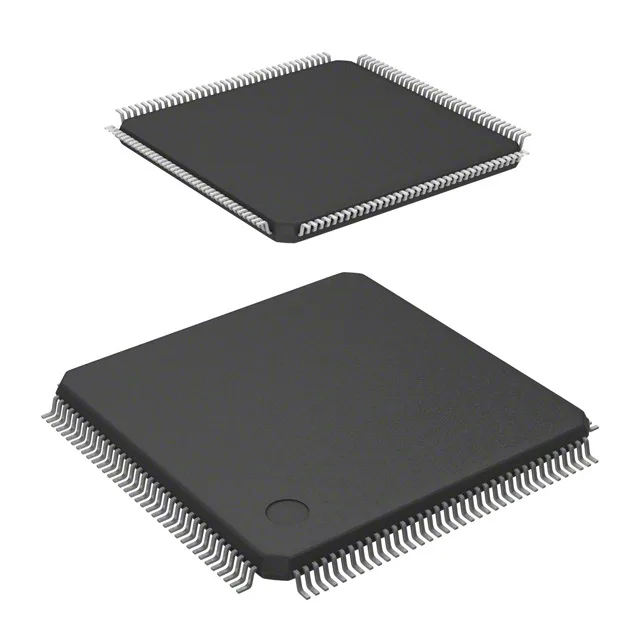
Dual-core architecture — what the speed split means for your firmware partition
The STM32H745ZIT6 runs a Cortex-M4 at 240 MHz and a Cortex-M7 at 480 MHz on the same die. That asymmetric pair lets you offload real-time control loops or communications stacks to the M4 while the M7 handles number-crunching or display rendering. The 2 MB Flash and 1 MB SRAM give each core its own code and data region without starving the other — useful when one core runs a FreeRTOS instance and the other runs bare-metal interrupt service.
Peripheral set — what connects without an external bridge
This part carries Ethernet MAC, USB OTG HS/FS, two CAN FD controllers, QSPI for external Flash, and a parallel EBI/EMI bus for SRAM or FPGA glue. That means one MCU can serve as the system host with Ethernet to a PLC, USB to a service port, and CAN to motor drives — no separate PHY or bridge IC needed for the basic topology. The 97 GPIOs in a 144-LQFP package leave enough headroom for a local keypad and status LEDs alongside the main interfaces.