Dual-core architecture — 240 MHz Cortex-M4 plus 480 MHz Cortex-M7
The STMicroelectronics STM32H745XIH6U is a 32-bit dual-core microcontroller from the STM32H7 series, pairing an ARM Cortex-M4 core running at 240 MHz with a Cortex-M7 core at 480 MHz. This asymmetric architecture lets you offload real-time control loops or communication stacks to the M4 while the M7 handles number-crunching, signal processing, or graphics. With 2 MB of Flash and 1 MB of RAM on-chip, there is room for a full RTOS, a TCP/IP stack, and a moderate-size frame buffer without external memory. The part includes an Ethernet MAC, two CANbus interfaces, USB OTG, and a QSPI interface — the connectivity set that drives the board-level routing decisions for industrial gateways, motor drives, or display panels.
2 MB Flash and 1 MB RAM — memory budget for firmware and data
Program memory is 2 MB of Flash, organised as 2M x 8, which is enough for a full-featured application with a bootloader, OTA staging area, and a file system. The 1 MB of RAM (1M x 8) supports large data buffers, double-buffered display frames, or a heap for dynamic allocation in a real-time OS.
Industrial temperature range and BGA footprint
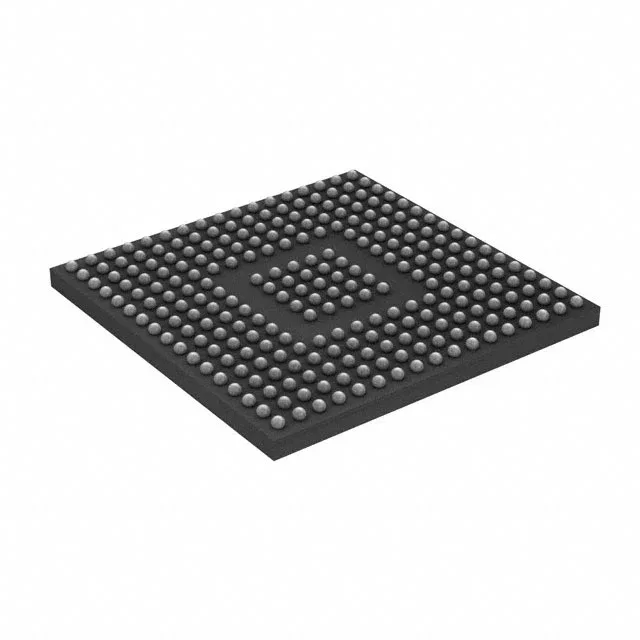
The package is a 265-ball TFBGA in a 14x14 mm body with a 240+25 ball count (240 functional I/O plus 25 reserved). That fine-pitch BGA demands a multi-layer PCB with controlled impedance for the Ethernet and QSPI traces; a four-layer board is the practical minimum, and six layers are common for signal integrity on the high-speed peripherals.
For a BOM line going into a new design, this is the right lifecycle tier — no supply-chain contingency needed for obsolescence during the product's expected production run.