Dual-core architecture: what the 240 MHz and 480 MHz cores mean for your task split
The STM32H745IIK3 pairs a Cortex-M4 running at 240 MHz with a Cortex-M7 at 480 MHz. The M7 handles throughput-heavy work — signal processing, graphics, or protocol stacks — while the M4 takes real-time control loops, low-level peripheral management, or safety monitoring. This asymmetric split avoids a single-core bottleneck without the overhead of an external companion chip. The 2 MB Flash and 1 MB RAM give both cores enough room for non-trivial firmware images and data buffers without external memory in many designs.
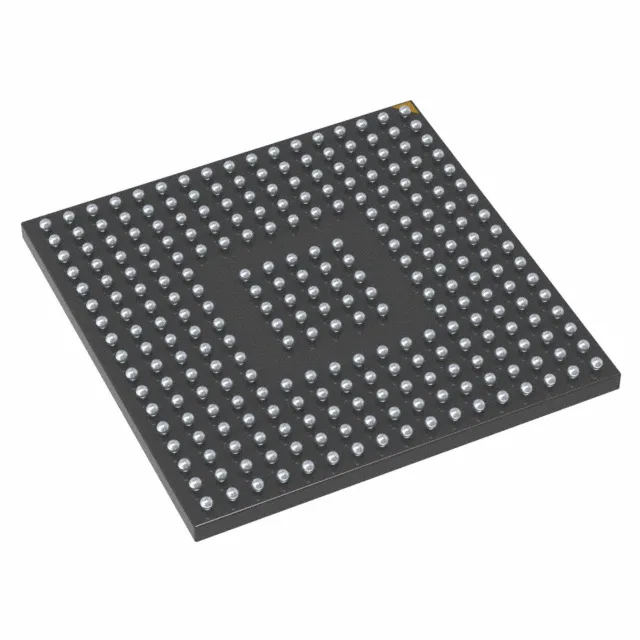
The 176+25 UFBGA (10x10 mm) is a fine-pitch BGA — expect 0.5 mm ball pitch, which demands a controlled-impedance stackup and via-in-pad for the inner balls. The 128 I/O count gives enough headroom for a parallel display interface, external memory bus, and multiple serial peripherals without a port expander.
Peripheral set and connectivity — what you can attach without glue logic
The connectivity list covers CANbus, Ethernet, USB OTG, multiple SPI/I2C/UART, QSPI, and an external memory interface (EBI/EMI). That means a single chip can handle a touchscreen display, an Ethernet PHY, a CAN transceiver, and a QSPI NOR Flash for code shadowing — no CPLD or extra MCU needed.
STMicroelectronics lists the STM32H745IIK3 as Active. For dual-source planning, the STM32H745 family shares pin-compatibility across density options (same package, same footprint), so a move to a higher-Flash sibling is a BOM-line change, not a board respin.