The analog front end is substantial: 26 channels of 12-bit ADC and four 12-bit DAC channels, so a single chip can handle multiple sensor inputs and generate analog setpoints or reference voltages without external converters.
The 170 MHz core speed puts this part in the performance tier where you can run a single-precision FFT or a PID loop at control-loop rates without a separate DSP. The Cortex-M4 includes a single-cycle multiply-accumulate and a hardware divider, so the 170 MHz clock translates to real throughput on math-heavy tasks, not just a headline number. If you are coming from a 72 MHz or 100 MHz MCU, the step to 170 MHz gives roughly 1.7× to 2.4× more instruction throughput on arithmetic, which can simplify the firmware architecture by eliminating hand-optimised assembly for time-critical loops.
Memory budget and firmware strategy
The 128 KB SRAM supports multiple data buffers, a few kilobytes of stack per task, and a DMA ring buffer for ADC samples without spilling to external memory. The Flash is organised for sector erase; if you plan over-the-air or field-updatable firmware, budget one or two sectors for a bootloader and a staging area. The 512 KB total gives you room for a dual-bank scheme if the application image is under 256 KB.
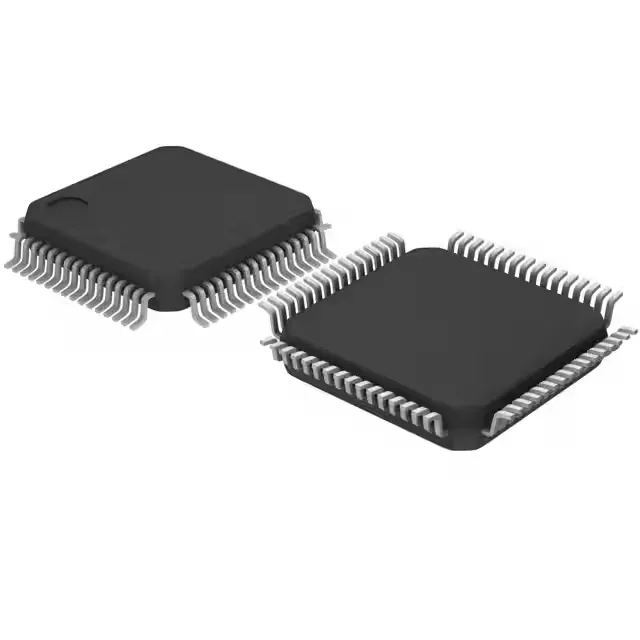
Housed in a 64-pin LQFP with a 10×10 mm body, the STM32G484RET6 is a hand-solderable, inspectable package that suits prototype builds and production reflow. The 52 I/O lines give enough GPIO for a sensor array, a keypad, and a parallel LCD interface while leaving serial peripherals free.
That makes it a safe choice for a new design that will run for several years. For BOM resilience, the STM32G4 family includes several pin-compatible siblings with different Flash/RAM and peripheral mixes. Qualifying a second source within the family — such as the STM32G474RET6 — can be done at the board-layout stage by checking the pinout compatibility in the STM32G4 reference manual.